
Medicines
SmPC of 24/03/2026
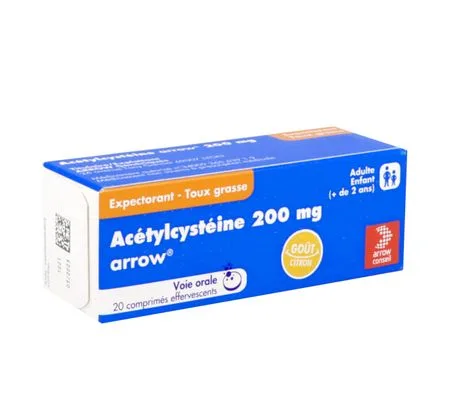
ACETYLCYSTEINE ARROW 200 mg, effervescent tablet
Composition
Acetylcysteine...........................................................................................................................................200,0 mg
For one effervescent tablet
Excipients with known effect: dextrin (glucose), lactose, sorbitol, sodium.
This medicine contains 75,0 mg of lactose, 0,325 mg of sorbitol and 100 mg of sodium per effervescent tablet.
Anhydrous citric acid, sodium bicarbonate, anhydrous sodium carbonate, anhydrous lactose, mannitol (E421), lemon flavouring (containing in particular sorbitol and dextrin), sodium cyclamate, sodium saccharin, sodium citrate.
Indications
Treatment of disorders of bronchial secretion, particularly during acute bronchial conditions: acute bronchitis and acute episodes of chronic bronchopneumopathies.
Dosage and administration
Dosage
Adults and children over 7 years
1 tablet 3 times a day.
Children from 2 to 7 years
1 tablet 2 times a day.
The duration of treatment should not exceed 8 to 10 days without medical advice.
Method of administration
Oral use.
Allow the tablet to dissolve completely in half a glass of water.
Contraindications
• Hypersensitivity to the active substance or to any of the excipients listed in section Composition.
• Infant (less than 2 years old) (see section Warnings and precautions).
Warnings and precautions
Productive coughs, which are a fundamental element of bronchopulmonary defence, should be preserved.
The combination of bronchial mucomodifiers with antitussives and/or secretion-drying substances (antimuscarinics) is irrational.
Mucolytics may induce bronchial overload in infants. Indeed, their capacity to drain bronchial mucus is limited, due to the physiological characteristics of their respiratory tree. They should therefore not be used in infants (see section Contraindications and Adverse effects).
Treatment should be re-evaluated if symptoms or the condition persist or worsen.
Caution is recommended in patients with gastroduodenal ulcer.
Excipients with known effect
This medicine contains dextrin (glucose) (contained in the flavouring). Patients with glucose-galactose malabsorption syndrome (a rare hereditary disease) must not take this medicine.
This medicine contains lactose. Patients with galactose intolerance, total lactase deficiency or glucose-galactose malabsorption syndrome (rare hereditary diseases) must not take this medicine.
This medicine contains 0,325 mg of sorbitol (contained in the flavouring) per effervescent tablet. The additive effect of concomitantly administered products containing sorbitol (or fructose) and the dietary intake of sorbitol (or fructose) must be taken into account. The sorbitol content of medicines for oral use may affect the bioavailability of other medicines for oral use administered concomitantly.
This medicine contains 100 mg of sodium per effervescent tablet, which is equivalent to 5 % of the WHO-recommended maximum daily dietary intake of 2 g of sodium per adult.
Fertility, pregnancy and breastfeeding
Pregnancy
There are limited data on the use of acetylcysteine in pregnant women.
Studies carried out in animals have not shown direct or indirect harmful effects on reproduction.
As a precaution, it is preferable to avoid the use of ACETYLCYSTEINE ARROW during pregnancy.
The benefit/risk ratio should be assessed before use during pregnancy.
Breast-feeding
There are no data on the passage of acetylcysteine into breast milk. However, given its low toxicity, the potential risks for the infant appear negligible when treated with this medicine.
Consequently, breastfeeding is possible.
Adverse effects
• Risk of bronchial congestion, particularly in infants and in certain patients unable to expectorate effectively (see sections Contraindications and Warnings and precautions).
Skin and subcutaneous tissue disorders
• Allergic skin reactions such as pruritus, erythematous rash, urticaria and angioedema.
Gastrointestinal disorders
• Frequent (≥ 1/100, < 1/10): abdominal pain, nausea, diarrhoea, dyspepsia, gastric disorder.
Reporting of suspected adverse reactions
Reporting suspected adverse reactions after authorisation of the medicinal product is important. It allows continued monitoring of the benefit/risk balance of the medicinal product. Healthcare professionals are asked to report any suspected adverse reaction via the national reporting system: National Agency for the Safety of Medicines and Health Products (ANSM) and the network of Regional Centres of Pharmacovigilance - Website: https://signalement.social-sante.gouv.fr/
Pharmacodynamics
Pharmacotherapeutic class: mucolytics, ATC code: R05CB01.
Acetylcysteine is a mucolytic-type mucomodifier. It acts on the gel phase of mucus, probably by breaking the disulfide bonds of glycoproteins, and thus promotes expectoration.
Pharmacokinetics
Acetylcysteine is rapidly absorbed; the peak plasma concentration is reached within one hour after oral administration of 200 to 600 mg.
Bioavailability is of the order of 4 to 10 % of the administered dose, probably due to intraluminal metabolism and a significant hepatic first-pass effect.
It is metabolised into several oxidised derivatives.
Its half-life is 2 hours. Renal clearance accounts for approximately 30 % of total clearance.
Special storage precautions
To be stored at a temperature not exceeding 30°C.
For storage conditions of the medicine after opening, see section Shelf life.
Prescription, supply and reimbursement
| Marketing authorisation (AMM) |
|
26 AVENUE TONY GARNIER
69007 LYON
Tel: 04 72 72 60 72 Tel (toll-free): 0811 65 27 76
contact@laboratoire-arrow.com
http://www.laboratoire-arrow.com/
Source: VIDAL · Updated on 10/11/2026. This information does not replace advice from a healthcare professional.