
Medicines
SmPC of 27/10/2017
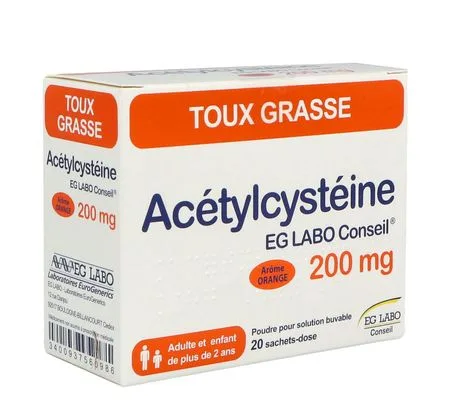
ACETYLCYSTEINE EG 200 mg, powder for oral solution in sachet-dose
Composition
Acetylcysteine........................................................................................................................................200,00 mg
For sachet-dose.
Excipients with known effect: Orange yellow S (E110), sucrose.
Sodium saccharin, sucrose, orange yellow S (E110), orange flavouring E216341 (containing maltodextrin, among others).
Indications
Treatment of bronchial secretion disorders, particularly during acute bronchial conditions: acute bronchitis and acute episode of chronic bronchopneumopathies.
Dosage and administration
Dosage
Adults and children over 7 years: 600 mg per day, in 3 doses, i.e. 1 sachet 3 times per day.
Children aged 2 to 7 years: 400 mg per day divided into 2 doses, i.e. 1 sachet 2 times per day.
The duration of treatment should not exceed 8 to 10 days without medical advice.
Method of administration
Oral use.
Dissolve the contents of the sachet in a little water.
No interaction with food has been reported; there is no indication regarding administration of the medicine before or after meals.
Contraindications
- Hypersensitivity to the active substance or to any of the excipients listed in section Composition ;
- Infant (under 2 years) (see section Warnings and precautions).
Warnings and precautions
Productive coughs, which are a fundamental element of bronchopulmonary defence, should be preserved.
The combination of a mucolytic with an antitussive and/or with a secretion-drying substance (antimuscarinic) is irrational.
Mucolytics may induce bronchial overload in infants. Indeed, their capacity to drain bronchial mucus is limited, due to the physiological characteristics of their respiratory tree. They should therefore not be used in infants (see section Contraindications and Adverse effects).
Caution is recommended when the product is used in patients with gastroduodenal ulcer or a history of this condition, particularly in case of concomitant administration of other medicines with a known irritant effect on the gastric mucosa.
Patients suffering from bronchial asthma must be closely monitored during treatment. In case of bronchospasm, acetylcysteine must be stopped immediately and appropriate treatment must be initiated.
Administration of acetylcysteine, mainly at the start of treatment, may liquefy bronchial secretions and increase their volume. If the patient is not able to expectorate effectively, postural drainage and bronchial suction must be performed.
Acetylcysteine may moderately influence histamine metabolism; therefore, caution is required when the medicine is administered long-term to patients with histamine intolerance, due to the possible occurrence of intolerance symptoms (headache, vasomotor rhinitis, pruritus).
A slight smell of sulphur does not indicate an alteration of the product but comes from the specific nature of the active ingredient.
The treatment should be re-evaluated in case of persistence or worsening of the symptoms or of the condition.
This medicine contains an azo colouring agent (orange yellow E110) and may cause allergic reactions.
This medicine contains sucrose. Its use is not recommended in patients with fructose intolerance, glucose-galactose malabsorption syndrome or sucrase/isomaltase deficiency.
Interactions
Antitussive medicines and mucolytic agents such as acetylcysteine must not be administered concomitantly, as the reduction of the cough reflex could lead to an accumulation of bronchial secretions.
Activated charcoal may reduce the effect of acetylcysteine.
Dissolving acetylcysteine formulations simultaneously with other medicines is not recommended.
Reports of antibiotic inactivation resulting from acetylcysteine are so far based only on in vitro tests in which the substances concerned were mixed directly. Nevertheless, when oral administration of antibiotics or other medicines is necessary, it is advised to administer them 2 hours apart from the intake of acetylcysteine. This does not apply to loracarbef.
Concomitant administration of nitrate derivatives and acetylcysteine has been shown to result in significant hypotension and an increase in vasodilation of the temporal artery. If concomitant treatment with a nitrate derivative and acetylcysteine is necessary, patients must be monitored for any hypotension that may be severe. They must also be warned of the possible occurrence of headaches.
Concomitant administration of acetylcysteine and carbamazepine may lead to sub-therapeutic carbamazepine concentrations.
Paediatric population
Interaction studies have only been carried out in adults.
Changes to laboratory tests
Acetylcysteine may cause interference with the colorimetric analytical method used for salicylate assay. Acetylcysteine may interfere with the assay of ketonuria.
Fertility, pregnancy and breastfeeding
There are limited data on the use of acetylcysteine in pregnant women. Animal studies have not shown direct or indirect harmful effects on reproduction (see section Preclinical safety).
As a precaution, it is preferable to avoid the use of ACETYLCYSTEINE EG during pregnancy.
The benefit/risk ratio must be assessed before use during pregnancy.
Breast-feeding
Data on the excretion of acetylcysteine and its metabolites in human milk are not known.
A risk to the breastfed child cannot be excluded.
A decision must be made either to discontinue breastfeeding or to discontinue/abstain from treatment with ACETYLCYSTEINE EG, taking into account the benefit of breastfeeding for the child against the benefit of the treatment for the woman.
Fertility
There are no data on the effect of acetylcysteine on human fertility. Animal studies have not shown harmful effects on human fertility at the recommended doses (see section Preclinical safety).
Driving and using machines
Acetylcysteine has no known effect on the ability to drive vehicles and use machines.
Adverse effects
Summary of the safety profile
The most frequent adverse effects associated with oral administration of acetylcysteine are gastrointestinal in nature. Hypersensitivity reactions including anaphylactic shock, anaphylactic/anaphylactoid reactions, bronchospasm, angioedema, rash and pruritus have been reported less frequently.
Tabulated summary of adverse reactions
The table below presents the adverse effects listed by system organ class and by frequency: very common (≥ 1/10); common (≥ 1/100, < 1/10); uncommon (≥ 1/1 000, < 1/100); rare (≥ 1/10 000, < 1/1 000); very rare (< 1/10 000); frequency not known (cannot be estimated from the available data).
Within each frequency group, the undesirable effects observed are presented in order of decreasing seriousness.
|
System Organ Classes |
Undesirable effects |
|||
|
Uncommon (≥1/1000 to <1/100) |
Rare (>1/10 000 to <1/1000) |
Very rare (< 1/10 000) |
frequency undetermined |
|
|
Immune system disorders |
Hypersensitivity |
|
Anaphylactic shock, anaphylactic/anaphylactoid reaction |
|
|
Nervous system disorders |
Headache |
|
|
|
|
Ear and labyrinth disorders |
Tinnitus |
|
|
|
|
Cardiac disorders |
Tachycardia |
|
|
|
|
Vascular disorders |
|
|
Haemorrhage |
|
|
Respiratory, thoracic and mediastinal disorders |
|
Bronchospasm, dyspnoea |
|
|
|
Gastrointestinal disorders |
Vomiting, diarrhoea, stomatitis, abdominal pain, nausea |
Dyspepsia |
|
|
|
Skin and subcutaneous tissue disorders |
Urticaria, rash, angioedema, pruritus |
|
|
|
|
General disorders and administration site conditions |
Fever |
|
|
Facial oedema |
|
Investigations |
Decreased arterial pressure |
|
|
|
There is also a risk of bronchial obstruction due to excess secretions, particularly in infants and in certain patients unable to expectorate effectively (see section Warnings and precautions).
Description of certain particular adverse effects
In very rare cases, severe adverse reactions such as Stevens-Johnson syndrome and Lyell's syndrome have been reported with a temporal link to the administration of acetylcysteine. In most cases, at least one other suspect medicine could be identified for which the probability of triggering the reported mucocutaneous syndrome is higher. If recent mucocutaneous reactions occur, medical advice should therefore be sought and treatment with acetylcysteine stopped immediately.
A decrease in platelet aggregation in the presence of acetylcysteine has been confirmed by various investigations. The clinical significance has not yet been established.
Reporting of suspected adverse reactions
Reporting suspected adverse reactions after authorisation of the medicinal product is important. It allows continued monitoring of the benefit/risk balance of the medicinal product. Healthcare professionals are asked to report any suspected adverse reaction via the national reporting system: National Agency for the Safety of Medicines and Health Products (ANSM) and the network of Regional Centres of Pharmacovigilance - Website: www.ansm.sante.fr.
Overdose
Healthy volunteers received 11,2 g of acetylcysteine per day orally for three months without experiencing serious adverse effects. Oral doses of up to 500 mg of acetylcysteine/kg of body weight were well tolerated without any symptoms of toxicity.
Symptoms
Overdoses may cause gastrointestinal symptoms, such as nausea, vomiting and diarrhoea.
Treatment
There is no antidote to acetylcysteine and treatment is symptomatic.
Pharmacodynamics
Pharmacotherapeutic class: MUCOLYTIC, ATC code: R05CB01
(R: Respiratory system)
Acetylcysteine is a mucolytic-type mucomodifier. It acts on the gel phase of mucus, probably by breaking the disulfide bonds of glycoproteins, and thus promotes expectoration.
Pharmacokinetics
Acetylcysteine is rapidly absorbed; the peak plasma concentration is reached within one hour after oral administration of 200 to 600 mg. Bioavailability is in the order of 4 to 10% of the administered dose, probably through intraluminal metabolism and a significant hepatic first-pass effect. It is metabolised into several oxidised derivatives. Its half-life is 2 hours. Renal clearance accounts for approximately 30% of total clearance.
Preclinical safety
Non-clinical data from conventional safety pharmacology, repeated-dose toxicity, genotoxicity and reproductive and developmental toxicity studies did not reveal any particular risk for humans.
In acute toxicity studies, the oral LD50 values were established at 8 g/kg and > 10 g/kg in mice and rats respectively.
With prolonged administration for 12 weeks, an oral dose of 1 g/kg/day was well tolerated in rats. In dogs, oral administration of 300 mg/kg/day for a duration of one year did not result in toxic reactions.
Acetylcysteine was considered not to be genotoxic based on the results of in vitro and in vivo assays.
Reproductive studies were carried out in rats at oral doses of up to 2 000 mg/kg per day and in rabbits at oral doses of up to 1 000 mg/kg per day; they did not demonstrate any impairment of female fertility or harmful effects on the foetus due to acetylcysteine. Furthermore, treatment of male rats with acetylcysteine at an oral dose of 250 mg/kg per day for 15 weeks did not affect fertility or general reproductive performance of the animals.
Prescription, supply and reimbursement
| Marketing authorisation (AMM) |
|
CENTRAL PARK 9-15 RUE MAURICE MALLET
92130 ISSY-LES-MOULINEAUX
Tel: 01 46 94 86 86 contact@eglabo.fr
https://www.eglabo.fr/
Source: VIDAL · Updated on 10/11/2026. This information does not replace advice from a healthcare professional.