
Medicines
SmPC of 27/02/2020
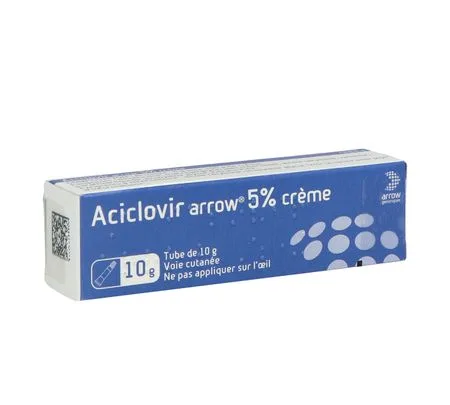
ACICLOVIR ARROW 5 %, cream
Composition
Aciclovir ...............................................................................................................................................................5 g
For 100 g of cream
Excipients with known effect: 1,5 g of cetyl alcohol, 15 g of propylene glycol.
Dimeticone, stearic macrogolglycerides, cetyl alcohol, petrolatum, liquid paraffin, propylene glycol, purified water.
Indications
Treatment of primary genital infection due to Herpes Simplex Virus and any subsequent recurrences.
Because of its mode of action, aciclovir does not eradicate latent viruses. After treatment, the patient will therefore remain exposed to the same frequency of recurrence as before.
Dosage and administration
Dosage
5 applications per day.
Treatment should be started as early as possible, at the first signs of infection.
Treatment should be continued for at least 5 days.
The duration of treatment must not exceed 10 days.
Method of administration
Cutaneous use.
Contraindications
- Hypersensitivity to aciclovir, to valaciclovir or to any of the excipients listed in section Composition
Warnings and precautions
Ocular, intraoral or intravaginal application of the cream is not recommended due to the risk of irritation.
For severely immunocompromised patients (for example, patients with AIDS or patients who have undergone bone marrow transplantation), oral administration of aciclovir should be considered. These patients are advised to consult a doctor regarding the treatment of any infection.
Related to excipients
This medicine contains cetyl alcohol. May cause local skin reactions (for example contact dermatitis).
This medicine contains propylene glycol. May cause skin irritation.
Fertility, pregnancy and breastfeeding
Pregnancy
The use of aciclovir during pregnancy should only be considered if the expected benefits outweigh the potential risks. However, systemic absorption of aciclovir following topical application of the cream is very low.
A post-marketing pregnancy registry has documented the pregnancy outcomes of women exposed to aciclovir (regardless of the form used). Registry data did not show an increase in the number of malformations in women exposed to aciclovir compared with the general population. No malformation showed an exceptional or recurrent pattern suggesting a common cause.
Systemic administration of aciclovir in standard international tests did not show embryotoxic effects or teratogenic effects in rabbits, rats or mice.
During a non-standard test conducted in rats, fetal abnormalities were observed but only at very high subcutaneous doses, which were also toxic to the mother. The clinical relevance of these findings is uncertain.
Breast-feeding
Limited data in humans show that aciclovir passes into breast milk after systemic administration. However, the amount received by a breastfed infant following maternal use of the cream should be negligible.
Breastfeeding is possible during treatment with topical aciclovir.
Driving and using machines
There are no data on effects on the ability to drive vehicles or use machines.
Adverse effects
The following convention was used for the classification of adverse effects by frequency: very common (≥ 1/10), common (≥ 1/100 and < 1/10), uncommon (≥ 1/1000 and < 1/100), rare (≥ 1/10 000 and < 1/1000), very rare (< 1/10 000).
Data from clinical trials were used to assign frequency categories to adverse effects observed during clinical trials with aciclovir 3 % eye ointment.
Due to the nature of the observed adverse effects, it is not possible to determine which effects are related to administration of the medicine and which are related to the disease.
- Skin and subcutaneous tissue disorders
Uncommon: transient tingling or burning sensations may follow application of the cream, skin dryness, skin peeling or pruritus.
Rare: erythema, contact eczema following application of the cream.
Sensitivity tests showed that the reactions were more often due to the components of the cream than to aciclovir itself.
- Immune system disorders
Very rare: immediate hypersensitivity reactions including urticaria and Quincke's oedema.
Reporting of suspected adverse reactions
Reporting suspected adverse reactions after authorisation of the medicinal product is important. It allows continued monitoring of the benefit/risk balance of the medicinal product. Healthcare professionals are asked to report any suspected adverse reactions via the national reporting system: National Agency for the Safety of Medicines and Health Products (ANSM) and the network of Regional Pharmacovigilance Centres - Website:www.signalement-sante.gouv.fr.
Overdose
No adverse effects are expected if the entire contents of a cream tube containing 500 mg of aciclovir (10 g tube) are ingested orally.
Pharmacodynamics
Pharmacotherapeutic class: TOPICAL ANTIVIRAL, ATC code: D06BB03.
To be active, aciclovir must be phosphorylated to aciclovir triphosphate.
Only cells infected with the herpes virus can carry out this phosphorylation, thanks to a viral enzyme.
Aciclovir triphosphate selectively inhibits viral DNA polymerase. The succession of these two selective steps makes it possible to inhibit viral multiplication without interfering with normal cellular metabolism.
Pharmacokinetics
The passage of aciclovir into the general circulation is low after cutaneous application; plasma concentrations found after repeated applications of the cream are negligible (less than 0,01 micromole).
Aciclovir is weakly bound to plasma proteins: 9 to 33 %.
Prescription, supply and reimbursement
| Marketing authorisation (AMM) |
|
26 AVENUE TONY GARNIER
69007 LYON
Tel: 04 72 72 60 72 Tel (toll-free): 0811 65 27 76
contact@laboratoire-arrow.com
http://www.laboratoire-arrow.com/
Source: VIDAL · Updated on 10/11/2026. This information does not replace advice from a healthcare professional.