
Medicines
SmPC of 18/06/2019
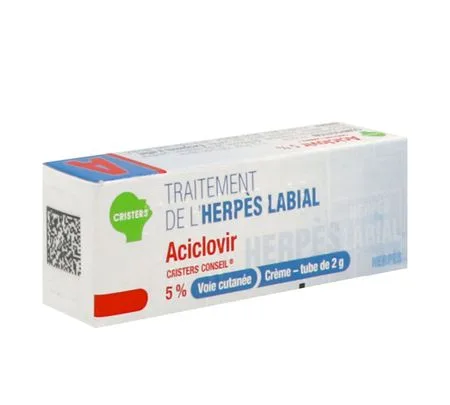
ACICLOVIR CRISTERS CONSEIL 5%, cream
Composition
Aciclovir................................................................................................................................................................5 g
For 100 g of cream.
Excipients with known effect: propylene glycol, cetyl alcohol.
Stearic macrogolglycerides, dimethicone, cetyl alcohol, liquid paraffin, petrolatum, propylene glycol, purified water.
Indications
Treatment of outbreaks of localised herpes labialis (also called "fever blisters").
Aciclovir is indicated in adults and in children aged over 6 years.
Dosage and administration
Cutaneous use.
Reserved for adults and children over 6 years of age.
Apply the cream 5 times daily, to the herpetic lesions located exclusively on the lips.
The duration of treatment must not exceed 10 days.
Wash hands thoroughly before and after applying the cream to the lesion.
Treatment is more effective if started at the first symptoms announcing an outbreak of herpes labialis.
Contraindications
Children under 6 years of age.
Hypersensitivity to the active substance or to any of the excipients listed in section Composition.
Warnings and precautions
Intrabuccal or intravaginal application of the cream is not recommended as it may be irritating to mucous membranes. Avoid contact with the eyes.
In immunocompromised patients, oral treatment with aciclovir should be considered. Such patients should be advised to consult their physician immediately for the treatment of any infection.
This medicine contains propylene glycol. Propylene glycol may cause skin irritation.
This medicine contains cetyl alcohol. Cetyl alcohol may cause local skin reactions (for example contact dermatitis).
Fertility, pregnancy and breastfeeding
Pregnancy
Analysis of about one thousand pregnancies exposed to aciclovir revealed no malformative or foetotoxic effect specific to aciclovir.
Consequently, use of aciclovir by the cutaneous route is possible in pregnant women within the scope of the indications.
Breast-feeding
If the maternal condition permits, breastfeeding is possible during treatment with this medicine.
Adverse effects
Transient tingling or burning sensations may follow application of the cream.
In a few patients, erythema or dry skin has been observed.
Reporting of suspected adverse reactions
Reporting suspected adverse reactions after authorisation of the medicinal product is important. It allows continued monitoring of the benefit/risk balance of the medicinal product. Healthcare professionals are asked to report any suspected adverse reactions via the national reporting system: National Agency for the Safety of Medicines and Health Products (ANSM) and the network of Regional Pharmacovigilance Centres - Website:www.signalement-sante.gouv.fr.
Overdose
No adverse effects are expected in case of ingestion of the entire contents of a tube of 10 g of cream containing 500 mg of aciclovir.
Doses of 800 mg 5 times per day were administered orally for 7 days in the treatment of herpes zoster without adverse effects.
Intravenous administration of a single dose of 80 mg/kg did not cause any adverse effects.
Pharmacodynamics
Pharmacotherapeutic class: ANTIVIRALS, ATC code: D06BB03.
Aciclovir, through contact with the infected cell, is transformed into aciclovir triphosphate and acts on herpes simplex viruses by blocking viral multiplication through selective inhibition of viral DNA polymerase.
Aciclovir does not eradicate latent viruses.
Aciclovir itself is a pharmacodynamically inactive compound. After penetrating cells infected by herpes simplex virus (HSV), aciclovir is converted into its active form, aciclovir triphosphate. This conversion is catalysed by the HSV thymidine kinase, an enzyme essential for viral replication. HSV thus ensures the synthesis of its own antiviral agent. The affinity of aciclovir for viral DNA polymerase is 10-20 times higher than its affinity for cellular DNA polymerase.
Aciclovir thus selectively inhibits viral enzymatic activity. Viral DNA polymerase incorporates aciclovir into viral DNA.
Aciclovir lacks a 3'-hydroxyl group; as a result, no other nucleotide can be added through formation of 3'-5' bonds, which leads to chain termination and therefore an effective reduction of viral replication.
Both herpes simplex virus species, type 1 and type 2, are highly sensitive to aciclovir.
In profoundly immunocompromised patients, prolonged or repeated treatment with aciclovir may lead to the selection of viral strains with decreased sensitivity. Consequently, these patients will no longer respond to aciclovir treatment.
Pharmacokinetics
Aciclovir penetrates the skin. At steady state, intradermal aciclovir concentrations are above the minimum inhibitory concentration in tissue.
Aciclovir is not detectable in the blood after application to the skin. The results reported below concern oral or intravenous administration.
The main metabolite is 9-(carboxymethoxymethyl) guanine. It represents 10 to 15 % of the medicinal product excreted via the renal route. The majority of the amount of aciclovir reaching plasma is eliminated unchanged by the kidneys (both by glomerular filtration and tubular excretion).
The plasma half-life of aciclovir in patients with normal renal function is approximately 3 hours. Binding to plasma proteins is relatively low (9-33 %). Interactions through displacement from protein binding sites are therefore unlikely.
Preclinical safety
A large number of tests in vitro showed that chromosomal damage is possible at very high doses. In studies in vivo, chromosomal damage was not observed. Long-term studies in rats and mice did not reveal any carcinogenic effect of aciclovir. In tests standardised according to international standards, systemic administration of aciclovir to various animal species did not produce embryological or teratogenic effects. In a non-standardised test in rats, effects on the foetus were observed only at very high doses that also caused maternal toxicity.
INCOMPATIBILITIES
In the absence of compatibility studies, this medicinal product must not be mixed with other medicinal products.
Prescription, supply and reimbursement
| Marketing authorisation (AMM) |
|
22 QUAI GALLIENI
92150 SURESNES
Tel: 01 42 04 88 94 https://www.laboratoirecristers.com/
Source: VIDAL · Updated on 10/11/2026. This information does not replace advice from a healthcare professional.