
Medicines
SmPC of 28/11/2024
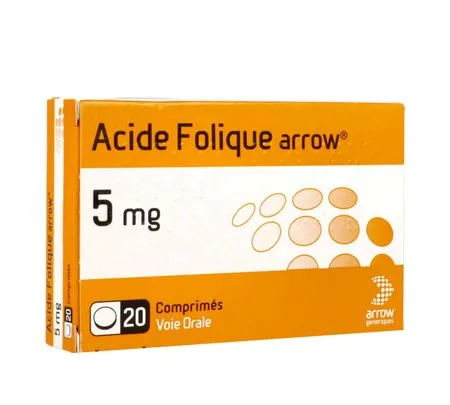
FOLIC ACID ARROW 5 mg, tablet
Composition
Folic acid.................................................................................................................................................... 5 mg
For one tablet
Excipient with known effect: lactose.
Lactose monohydrate, microcrystalline cellulose, maize starch, anhydrous colloidal silica, magnesium stearate.
Indications
Macrocytic anaemias due to folic acid deficiency.
Chronic disorders of intestinal absorption, whatever their origin.
Dietary deficiencies: malnutrition, alcoholism.
Pregnancy, in case of proven deficiency. In women who have already had children with neural tube closure abnormalities (spina bifida), some authors have observed that periconceptional folic acid supplementation of 5 mg per day in the month preceding and the 3 months following conception reduced the recurrence of the malformation risk for subsequent pregnancies.
Nevertheless, antenatal diagnosis to screen for this type of malformation remains essential.
Dosage and administration
Dosage
Adults (including the elderly)
In case of megaloblastic anaemia due to folic acid deficiency
5 mg per day, for 4 months; the dose may be increased up to 15 mg per day in case of chronic disorders of intestinal absorption.
Prevention of neural tube closure abnormalities (spina bifida) in the foetus in women planning a pregnancy and known to be at risk
5 mg per day. Treatment must start at least 3 months before conception and continue throughout the 1er trimester of pregnancy.
Pregnancy
In case of proven deficiency
5 mg per day, until the end of pregnancy.
Children
Folic acid must not be used in children under 6 years since the tablet form is not suitable for children under 6 years.
In case of megaloblastic anaemia due to folic acid deficiency
In children and adolescents aged 6 to 18 years: 5 mg per day, for 4 months; maintenance treatment: 5 mg every 1 to 7 days.
In case of haemolytic anaemia
In children and adolescents aged 6 to 12 years: 5 mg per day.
In children and adolescents aged 12 to 18 years: 5 mg to 10 mg per day.
Method of administration
Oral use.
Contraindications
• Hypersensitivity to the active substance or to any of the excipients listed in section Composition.
• Undiagnosed megaloblastic anaemia, including that of early childhood, pernicious anaemia or macrocytic anaemia of unknown aetiology, unless treatment is given with adequate amounts of hydroxocobalamin.
Warnings and precautions
Patients with vitamin B12 deficiency must not be treated with folic acid, unless treatment is given with adequate amounts of hydroxocobalamin. Indeed, treatment with folic acid alone may mask the patient's condition but does not treat the subacute and irreversible damage caused by vitamin B12 deficiency to the nervous system. Vitamin B12 deficiency may be due to undiagnosed megaloblastic anaemia, including that of early childhood, to pernicious anaemia, to macrocytic anaemia of unknown aetiology, or to any other cause of cobalamin deficiency, such as having been vegetarian for a long time.
Folic acid must not be used in cases of malignant disease, unless megaloblastic anaemia due to folic acid deficiency represents a major complication.
The administration of folic acid to patients with folate-dependent tumours must be considered and monitored with the greatest care.
This medicine is not intended for healthy pregnant women, for whom lower doses are then recommended. This medicine is intended for pregnant women with folic acid deficiency and for pregnant women who have already had children with neural tube closure abnormalities (spina bifida) and who are therefore said to be at risk.
Excipient with known effect
This medicine contains lactose. Patients with galactose intolerance, total lactase deficiency or glucose-galactose malabsorption syndrome (rare hereditary diseases) must not take this medicine.
Interactions
+ Antiepileptics
If folic acid is prescribed to treat folate deficiency caused by antiepileptics (phenytoin, phenobarbital and primidone), the plasma concentrations of these anticonvulsants may be decreased. These levels may be lowered to the point that convulsions in some patients may no longer be well controlled.
+ Antibiotics
Chloramphenicol and co-trimoxazole may interfere with the metabolism of folic acid.
+ Sulfasalazine
Sulfasalazine may reduce the absorption of folic acid.
Fertility, pregnancy and breastfeeding
Pregnancy
There are no known dangers in using folic acid during pregnancy. Folic acid supplementation is often beneficial.
Folate deficiency, or abnormal folate metabolism, induced by non-medicinal products, is linked to the occurrence of defects in newborns and certain neural tube closure abnormalities.
Concomitant administration, early in pregnancy, of certain medicines inducing a disturbance of folic acid metabolism or folate deficiency (such as anticonvulsants or certain antineoplastics) may cause congenital abnormalities.
A lack of folic acid (vitamin B9) or of its metabolites may also be responsible for certain cases of spontaneous abortion or intrauterine growth retardation.
Breast-feeding
Folic acid is excreted in breast milk. Folate accumulates in breast milk when folic acid intake during pregnancy exceeds the mother's needs.
The folic acid concentration is relatively low in colostrum. The folic acid concentration is higher in mature breast milk.
No adverse effects have been observed in infants who were breastfed by a mother who received folic acid supplementation during pregnancy.
Adverse effects
Adverse effects are listed by MedDRA system organ class. Within each system organ class, adverse events are presented in order of decreasing frequency according to the following CIOMS III convention: very common (≥ 1/10), common (≥ 1/100, < 1/10); uncommon (≥ 1/1 000; < 1/100); rare (≥ 1/10 000; < 1/1 000); very rare (< 1/10 000) and frequency not known (cannot be estimated from the available data).
Immune system disorders
• Frequency not known: anaphylactic reaction such as urticaria and angioedema.
• Very rare: cutaneous allergic reaction.
Gastrointestinal disorders
• Frequency not known: gastrointestinal disorder.
Reporting of suspected adverse reactions
Reporting suspected adverse reactions after authorisation of the medicinal product is important. It allows continued monitoring of the benefit/risk balance of the medicinal product. Healthcare professionals are asked to report any suspected adverse reaction via the national reporting system: National Agency for the Safety of Medicines and Health Products (ANSM) and the network of Regional Centres of Pharmacovigilance - Website: https://signalement.social-sante.gouv.fr/.
Overdose
Excessive intake of folic acid is followed by an increase in urinary elimination.
No special procedures and no antidote are necessary.
Pharmacodynamics
Pharmacotherapeutic class: anti-anaemic preparation, ATC code: B03BB01.
Folic acid is one of the coenzymes involved in certain trans-methylations, such as the synthesis of deoxyribonucleic acid and the synthesis of ribonucleic acid.
Folic acid is a vitamin of the B group. Folic acid is necessary for the production and maturation of red cell lineage cells. A deficiency in folic acid is one of the causes of megaloblastic anaemia.
Pharmacokinetics
Absorption
Folic acid is rapidly absorbed from the gastrointestinal tract, mainly through the proximal part of the small intestine. Dietary folates have a bioavailability twice as low as pure folic acid.
In the intestine, natural folates such as polyglutamates are deconjugated and reduced by dihydrofolate reductase to 5-methyl-tetrahydrofolate (5-MTHF). Folic acid given therapeutically enters the portal circulation, for the great majority in unchanged form, since folic acid is not a good substrate for reduction by dihydrofolate reductases.
Distribution
Distribution occurs via the portal circulation. 5-methyl-tetrahydrofolate (5-MTHF) is predominantly bound to plasma proteins. Folic acid concentrates in the cerebrospinal fluid and is mainly stored in the liver. Folic acid passes into breast milk.
Biotransformation
Folic acid given therapeutically is converted in the liver and blood plasma to 5-methyl-tetrahydrofolate (5-MTHF), an active metabolite. There is an enterohepatic circulation for folic acid.
Elimination
The metabolites of folic acid are eliminated via the urine. Excess folic acid is excreted in the urine in unchanged form. Haemodialysis allows the elimination of folic acid.
Preclinical safety
In pre-clinical studies, the effects that could be observed occurred at an exposure far exceeding human exposure and are therefore of little relevance to clinical use.
Special storage precautions
Store at a temperature not exceeding 25°C.
Store in the original package, protected from light.
Prescription, supply and reimbursement
| Marketing authorisation (AMM) |
|
| Price: |
|
Collection.
26 AVENUE TONY GARNIER
69007 LYON
Tel: 04 72 72 60 72 Tel (toll-free): 0811 65 27 76
contact@laboratoire-arrow.com
http://www.laboratoire-arrow.com/
Source: VIDAL · Updated on 10/11/2026. This information does not replace advice from a healthcare professional.