
Medicines
SmPC of 28/07/2025
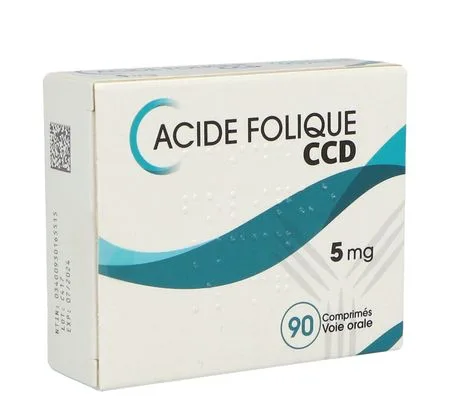
FOLIC ACID CCD 5 mg, tablet
Composition
For one tablet:
Folic acid: 5 mg
Microcrystalline cellulose, pregelatinised maize starch, magnesium trisilicate, magnesium stearate, anhydrous colloidal silica.
Indications
Macrocytic anaemias due to folic acid deficiency.
Chronic disorders of intestinal absorption, whatever their origin.
Dietary deficiency: malnutrition, alcoholism.
Pregnancy: in case of proven deficiency. In women who have already had children with neural tube closure abnormalities (spina bifida), some authors have observed that periconceptional folic acid supplementation of 5 mg per day in the month before and the 3 months after conception reduced the recurrence of the malformation risk in subsequent pregnancies.
Nevertheless, antenatal diagnosis to screen for this type of malformation remains essential.
Dosage and administration
Dosage
Daily doses range between 5 and 15 mg, i.e. 1 to 3 tablet(s) per day.
Pregnancy, in case of proven deficiency: see section Indications.
Contraindications
Hypersensitivity to the active substance or to any of the excipients listed in section Composition.
Interactions
Associations requiring precautions for use
+ Phenobarbital, phenytoin, primidone:
Decrease in plasma concentrations of enzyme-inducing anticonvulsants, due to increased hepatic metabolism of them, for which folates are one of the cofactors.
Clinical monitoring, possibly of plasma levels, and adjustment, if necessary, of the antiepileptic dosage during folic acid supplementation and after its discontinuation.
Fertility, pregnancy and breastfeeding
Pregnancy
There are no known dangers in using folic acid during pregnancy. Folic acid supplementation is often beneficial.
A deficiency in folates, or an abnormal folate metabolism, induced by medicinal products, is linked to the occurrence of defects in newborns and certain neural tube closure abnormalities.
Concomitant administration, early in pregnancy, of certain medicines inducing a disturbance of folic acid metabolism or folate deficiency (such as anticonvulsants or certain antineoplastics) may cause congenital abnormalities.
A lack of folic acid (vitamin B9) or of its metabolites may also be responsible for certain cases of spontaneous abortion or intrauterine growth retardation.
Breast-feeding
Folic acid is excreted in breast milk. Folate accumulates in breast milk when folic acid intake during pregnancy exceeds the mother's needs.
The concentration of folic acid is relatively low in colostrum. The concentration of folic acid is higher in breast milk.
No adverse effects have been observed in infants who were breastfed by a mother who received folic acid supplementation during pregnancy.
Adverse effects
Very rare cases of cutaneous allergic reactions.
Possibility of gastrointestinal disorders.
Anaphylactic reactions such as urticaria and angioedema have been reported with an unknown frequency.
Reporting of suspected adverse reactions
Reporting suspected adverse reactions after authorisation of the medicinal product is important. It allows continued monitoring of the benefit/risk balance of the medicinal product. Healthcare professionals are asked to report any suspected adverse reactions via the national reporting system: National Agency for the Safety of Medicines and Health Products (ANSM) and the network of Regional Pharmacovigilance Centres - Website: https://signalement.social-sante.gouv.fr/.
Pharmacodynamics
Pharmacotherapeutic class: Anti-anaemic preparation, ATC code: B03BB01
Folic acid is a vitamin of the B group. Its active metabolites serve as coenzymes for many enzymatic reactions involved in the synthesis of purines and the metabolism of amino acids.
Pharmacokinetics
Absorption
Folic acid is rapidly absorbed (5 to 20 minutes), the serum peak is observed 1 to 2 hours after absorption.
Distribution
It diffuses into all tissues and body fluids, it concentrates in the CSF and is stored in the liver. The mean serum level is 5 to 12 ng/mL.
Elimination
It is excreted in urine and feces.
Prescription, supply and reimbursement
| Marketing authorisation (AMM) |
|
| Price: |
|
CCD Laboratory
36, rue Brunel. 75017 Paris
Tel: 01 44 95 14 95. Toll-free number: 08 00 35 80 00
E-mail: infomed@ccdlab.com
Website: www.laboratoire-ccd.fr
Source: VIDAL · Updated on 10/11/2026. This information does not replace advice from a healthcare professional.