
Medicines
SmPC of 26/07/2022
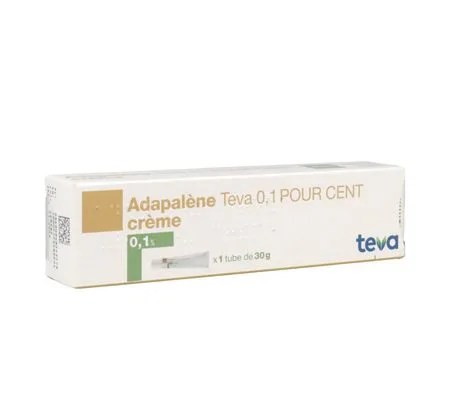
ADAPALENE TEVA 0,1 PER CENT, cream
Composition
Adapalene .......................................................................................................................................................... 0,1 g
For 100 g of cream.
Excipient with known effect : contains 0,25 g of methyl parahydroxybenzoate (E218) per 100 g of cream.
Methyl parahydroxybenzoate (E218), phenoxyethanol, carbomer 974 P, glycerol, disodium edetate, squalane, methyl glucose sesquistearate, macrogol 20 methyl glucose sesquistearate, cyclomethicone, sodium hydroxide, purified water.
Dosage and administration
Cutaneous use.
Apply the amount of a pea-sized quantity of cream, spreading it over the acne lesions while avoiding the eyes and lips, once daily at bedtime after washing and thoroughly drying the skin.
Clinical improvement should be visible after 4 to 8 weeks of treatment, with a clear improvement after 3 months of treatment. The tolerability of adapalene cream has been demonstrated over a period of 6 months of treatment. It is recommended to assess the patient's improvement after 3 months of treatment.
In case of treatment discontinuation or reduction in application frequency due to irritation phenomena, it is possible to resume or increase the application frequency again according to the patient's tolerance of the treatment.
An increase in the amounts applied would not improve the activity or speed of action of the product but could cause redness, desquamation and discomfort.
The tolerability and efficacy of ADAPALENE TEVA, cream have not been studied in children under the age of 12 years.
Contraindications
• Hypersensitivity to the active substance or to any of the excipients mentioned in section Composition.
• Pregnancy (see section Fertility, pregnancy and breastfeeding).
• Women planning a pregnancy.
Warnings and precautions
Special warnings
This medicine contains methyl parahydroxybenzoate (E 218) and may cause allergic reactions (possibly delayed).
Precautions for use
If a hypersensitivity-type reaction or severe irritation occurs, use of the cream should be temporarily or permanently discontinued.
In case of accidental application to mucous membranes (eyes, mouth, nostrils) or to open wounds, rinse thoroughly with lukewarm water.
Due to the slightly irritating nature of the cream, concomitant use of astringent cleansing cosmetic products and drying or irritating agents (such as perfumed or alcohol-containing products) should be avoided.
Adapalene cream applied in the evening may also be used with other anti-acne treatments applied in the morning, for example, erythromycin (4 %) or clindamycin (1 %) lotions or aqueous benzoyl peroxide gels at concentrations up to 10 %.
Exposure to sunlight and ultraviolet lamps causes additional irritation. Accordingly, avoid exposure during treatment as far as possible.
Treatment may however be continued if sun exposure is reduced to a minimum (protection by wearing a hat and using a sunscreen cream) and the application frequency adjusted.
In case of exceptional sun exposure (for example a day at the sea), do not apply the day before, on the same day, or the day after.
If previous exposure has caused sunburn ("sunburn"), wait for complete recovery before starting treatment.
Interactions
Adapalene is stable to oxygen and light and chemically non-reactive. Use of adapalene with other topical anti-acne medicines, such as clindamycin phosphate or benzoyl peroxide, does not produce mutual degradation.
As adapalene is poorly absorbed through the skin, interaction with medicines administered systemically is therefore unlikely.
Fertility, pregnancy and breastfeeding
Retinoids administered orally are associated with congenital abnormalities. When used in accordance with the prescribing information, topical retinoids are generally considered to result in low systemic exposure due to minimal dermal absorption. However, individual factors (for example: skin lesion, excessive use) may contribute to increased systemic exposure.
Pregnancy
ADAPALENE TEVA is contraindicated (see section Contraindications) in pregnant women or women planning a pregnancy.
Oral animal studies have shown reproductive toxicity at high systemic doses.
Clinical experience with locally applied adapalene during pregnancy is limited, but the few available data do not show a harmful effect in patients exposed early in pregnancy.
Due to the limited available data and the fact that very low skin penetration of adapalene is possible, ADAPALENE TEVA must not be used during pregnancy.
If used in a pregnant patient, or if a patient treated with this medicine becomes pregnant, treatment must be discontinued.
Breast-feeding
No study on passage into milk in animals or humans has been conducted after cutaneous application of ADAPALENE TEVA.
No effect on the breastfed infant is expected because systemic exposure to ADAPALENE TEVA in the breastfeeding woman is negligible.
ADAPALENE TEVA may be used during breastfeeding. To avoid accidental cutaneous exposure of the baby, application of ADAPALENE TEVA to the breast should be avoided during breastfeeding.
Adverse effects
Adverse effects reported during clinical trials and since the marketing of ADAPALENE TEVA are classified by System Organ Class and by frequency using the following categories: very common (≥1/10), common (≥1/100, < 1/10), uncommon (≥ 1/1000, < 1/100), rare (≥ 1/10000, < 1/1000), very rare (< 1/10000), frequency not known (cannot be estimated from the available data).
|
System Organ Class |
Frequency |
Adverse effects |
|
Skin and subcutaneous tissue disorders |
Common |
Dry skin, skin irritation, skin burning sensation, erythema. |
|
Uncommon |
Contact dermatitis, skin discomfort, sunburn, pruritus, skin exfoliation, acne. |
|
|
Not known* |
Allergic dermatitis (allergic contact dermatitis), skin pain, skin swelling, burning at the application site**, skin hypopigmentation, skin hyperpigmentation. |
|
|
Eye disorders |
Not known* |
Eyelid irritation, eyelid erythema, eyelid pruritus, eyelid swelling. |
|
Immune system disorders |
Not known* |
Anaphylactic reaction, angioedema |
* Data collected after marketing authorisation
**Most cases of "burning at the application site" were superficial cases, but second-degree burn reactions have been reported.
Reporting of suspected adverse reactions
Reporting suspected adverse reactions after authorisation of the medicinal product is important. It allows continued monitoring of the benefit/risk balance of the medicinal product. Healthcare professionals are asked to report any suspected adverse reaction via the national reporting system: National Agency for the Safety of Medicines and Health Products (ANSM) and the network of Regional Centres of Pharmacovigilance - Website: www.signalement-sante.gouv.fr.
Overdose
Oral toxicity in mice is greater than 10 mg/kg. Despite the low risk of accidental ingestion, the possibility of gastric lavage should be considered.
Pharmacodynamics
Pharmacotherapeutic class: ANTI-ACNE RETINOIDS FOR TOPICAL USE. ATC code : D10AD03.
Although polytherapy is frequent in the treatment of acne, the classification adopted: severe acne, moderate acne, mild to moderate acne was established in the context of monotherapy.
Adapalene is a retinoid-type compound, chemically stable, which in addition has anti-inflammatory properties. In terms of mechanism of action, adapalene binds in the same way as tretinoin to specific nuclear receptors but not to the cytosolic receptor protein.
Adapalene has comedolytic activity in the rhino mouse model and also has effects on the abnormal processes of keratinization and epidermal differentiation, both of which are present in the pathogenesis of acne. The mode of action of adapalene appears to be a normalization of the cohesion of follicular epithelial cells, which results in a reduction in the formation of microcomedones.
Adapalene has anti-inflammatory activity in vivo and in vitro (standard anti-inflammatory tests). Adapalene acts by inhibiting the chemotactic and chemokinetic responses of human polymorphonuclear leukocytes as well as the metabolism of arachidonic acid by lipo-oxidation during inflammatory stimuli. This pharmacological profile may suggest an activity of adapalene on the inflammatory component of acne.
Pharmacokinetics
Adapalene is poorly absorbed through the skin (approximately 4% of the applied dose). Metabolism occurs mainly by O-demethylation, hydroxylation, conjugation; its excretion is observed mainly via the biliary route.
Preclinical safety
Preclinical data from conventional safety pharmacology, repeated-dose toxicology, genotoxicity and carcinogenicity studies revealed no particular risk for humans.
After oral administration corresponding to a significant plasma exposure, effects similar to a hypervitaminosis A syndrome were observed.
Reproductive toxicology studies have been conducted with adapalene by oral and cutaneous routes in rats and rabbits. A teratogenic effect was demonstrated at high systemic doses (oral doses of 25 mg/kg/day). At lower exposures (cutaneous dose of 6 mg/kg/day), a change in the number of ribs and vertebrae was observed.
Prescription, supply and reimbursement
| Marketing authorisation (AMM) |
|
| Price: |
|
Collection.
COEUR DEFENSE 100-110 ESPLANADE DU GAL DE GAULLE
92931 PARIS LA DEFENSE CEDEX
Tel: 01 55 91 78 00 www.teva-sante.fr
Source: VIDAL · Updated on 10/11/2026. This information does not replace advice from a healthcare professional.