
Medicines
SmPC of 22/09/2025
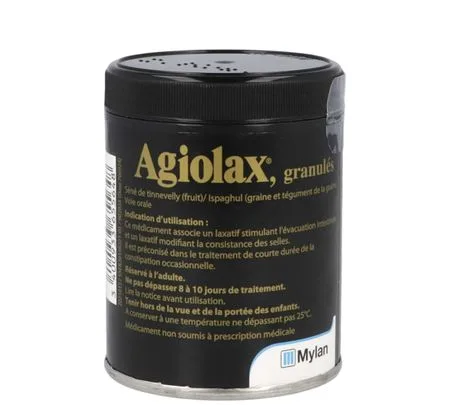
AGIOLAX, granules
Composition
Tinnevelly senna (fruit) ................................................................................................................6,74 - 13,15 g
(Quantity corresponding to 300 mg of sennosides expressed as sennoside B)
Psyllium (seed) ........................................................................................................................................52,00 g
Psyllium (seed husk) ...............................................................................................................2,20 g
For 100 g of granules.
One measuring spoonful contains 5 g of AGIOLAX, i.e. 15 mg of sennosides.
Excipient with known effect: sucrose.
For the complete list of excipients, see section Composition.
Talc, gum arabic, yellow iron oxide, black iron oxide, red iron oxide, caraway essential oil, Spanish sage essential oil, peppermint essential oil, solid paraffin, liquid paraffin, sucrose.
Dosage and administration
Dosage
Reserved for adults and children aged 12 years and over
1 to 2 measuring spoonfuls per day, i.e. 15 to 30 mg of sennosides expressed as sennoside B, preferably at the end of the evening meal.
The smallest dose allowing satisfactory transit and soft stools should be retained.
Paediatric population
Use in children under 12 years is contraindicated (see section Contraindications).
Method of administration
Place the dry granules in the mouth and swallow them while standing, without chewing, with a large glass of liquid:
• a hot drink at the end of the evening meal,
• a cold drink in the morning on an empty stomach,
• a highly carbonated drink for subjects with dental prostheses in order to avoid the granules adhering to the prosthesis.
AGIOLAX must be taken at least ½ to 1 hour before or after taking other medicines, and must not be taken before bedtime.
• Duration of treatment
Must not be used for more than 1 week (see section Warnings and precautions).
In general, taking this medicine two to three times during this week is sufficient.
If symptoms persist beyond one week, a doctor or pharmacist must be consulted.
Contraindications
This medicine is contraindicated in the following situations:
• hypersensitivity to the active substances or to any of the excipients mentioned in section Composition,
• organic inflammatory colopathies (ulcerative colitis, Crohn's disease, appendicitis...),
• obstructive or subobstructive syndrome, gastrointestinal strictures, atony, megacolon,
• abdominal pain syndromes of undetermined cause,
• diseases of the oesophagus and cardia,
• patients presenting with a sudden change in intestinal transit that persists for more than 2 weeks,
• undiagnosed rectal bleeding and no bowel movement after use of a laxative,
• difficulty swallowing or any other problem in the throat,
• states of severe dehydration with electrolyte depletion,
• children under 12 years,
• pregnancy and breastfeeding (see sections Fertility, pregnancy and breastfeeding and Preclinical safety).
Warnings and precautions
Special warnings
This medicine is generally not recommended in combination with medicines causing torsades de pointes (see section Interactions).
Patients taking cardiac glycosides, anti-arrhythmic medicines, medicines inducing QT interval prolongation, diuretics, corticosteroids or liquorice root, must consult a doctor before taking senna preparations concomitantly (see section Interactions).
Patients with fructose intolerance, glucose-galactose malabsorption syndrome or sucrase/isomaltase deficiency (rare hereditary diseases) must not take this medicine.
Patients suffering from renal pathologies must be warned of a risk of electrolyte imbalance.
Drug treatment of constipation is only an adjunct to hygienic-dietary treatment:
• enrichment of the diet with vegetable fibres and water,
• advice on physical activity and re-education of defecation.
Senna preparations should only be used if a therapeutic effect could not be obtained after a modification of the diet or administration of a bulk-forming laxative.
Prolonged intake of anthracene derivatives may lead to two series of disorders:
• "laxative disease" with severe functional colopathy, recto-colonic melanosis, hydro-electrolytic abnormalities with hypokalaemia; it is very rare.
• a situation of "dependence" with regular need for laxatives, need to increase the dosage and severe constipation on withdrawal; this dependence, whose onset varies between patients, may develop without the doctor's knowledge.
Prolonged use of a laxative is not recommended (do not exceed 1 week of treatment).
If a daily intake of laxatives is necessary, the cause of the constipation must be investigated.
This medicine is generally not recommended in children aged 12 to 15 years.
In children, prescription of stimulant laxatives should be exceptional: the risk of hindering the normal functioning of the defecation reflex must be taken into account.
Precautions for use
In cases of megacolon due to impaired colonic motility and in bedridden subjects, prescription must be cautious (risk of faecaloma).
As with all laxatives, senna or ispaghula preparations must not be taken by patients suffering from faecal impaction and undiagnosed acute or persistent gastrointestinal disorders, e.g. abdominal pain, nausea and vomiting, unless advised otherwise by a doctor, as these symptoms may be a sign of a latent or declared intestinal obstruction (ileus).
This medicine must not be taken lying down, nor dry (without liquid), in order to prevent the granules from stagnating in the digestive tract, which could cause oesophageal obstruction. A sufficient quantity of liquid must always be taken with each dose, for example a large glass of water.
When taken with insufficient quantities of liquid, bulk-forming agents such as ispaghula can cause obstruction of the throat and oesophagus with choking and intestinal obstruction. Symptoms may include chest pain, vomiting or difficulty swallowing or breathing.
When preparations containing senna are administered to incontinent adults, the nappies must be changed more frequently in order to avoid prolonged contact of the skin with stools. Treatment of weakened and/or elderly patients requires medical supervision. In elderly people, ensure that fluid intake is sufficient.
In order to reduce the risk of gastrointestinal obstruction (ileus), ispaghula seeds and their husks must only be used with medicines known to inhibit peristaltic movements (for example opioids) under medical supervision.
If symptoms worsen during use of AGIOLAX, a doctor or pharmacist must be consulted.
If constipation does not disappear within 3 days, or in the case of abdominal pain or irregular stools, use of AGIOLAX must be stopped and medical advice must be sought.
Interactions
Combinations not recommended
+ Medicines causing torsades de pointes
Amiodarone, astemizole, bepridil, bretylium, disopyramide, intravenous erythromycin, halofantrine, pentamidine, quinidine-like agents, sparfloxacin, sotalol, sultopride, terfenadine, vincamine.
Increased risk of ventricular disorders, in particular torsades de pointes. Use a non-stimulant laxative.
Associations requiring precautions for use
+ Cardiac glycosides
Hypokalaemia (resulting from long-term laxative abuse) promotes the toxic effects of cardiac glycosides.
Monitor serum potassium and, if necessary, ECG. Use a non-stimulant laxative.
+ Other potassium-lowering agents
Potassium-depleting diuretics (alone or in combination), amphotericin B (intravenous route), corticosteroids (glucocorticoids, mineralocorticoids: systemic route), tetracosactide.
Increased risk of hypokalaemia (additive effect).
Monitor serum potassium and correct if necessary. Use a non-stimulant laxative.
+ Other medicines
Enteral absorption of medicines administered concomitantly with AGIOLAX, such as minerals, vitamins (B 12), coumarin derivatives, carbamazepine and lithium, may be delayed. For this reason, AGIOLAX must be taken at least ½ to 1 hour before or after taking other medicines.
Diabetic patients must only take AGIOLAX under medical supervision, as an adjustment of antidiabetic treatment may be necessary.
Use of AGIOLAX in combination with thyroid hormones must be carried out under medical supervision, as an adjustment of the thyroid hormone dose may be necessary.
Fertility, pregnancy and breastfeeding
Pregnancy
Use during pregnancy is contraindicated due to experimental data concerning a genotoxic risk of several anthranoids, for example emodin and aloe-emodin.
Breast-feeding
Use during breastfeeding is contraindicated because, after administration of anthranoids, active metabolites such as rheine have been excreted in breast milk in small quantities.
Fertility
No fertility studies have been performed.
Driving and using machines
No studies on the effects on the ability to drive and use machines have been performed.
Adverse effects
Summary of the safety profile
Flatulence may occur during use of AGIOLAX granules, which generally disappears during treatment. Abdominal distension and a risk of intestinal or esophageal obstruction (for example, dysphagia) and fecaloma may occur, particularly if AGIOLAX granules is swallowed with an insufficient quantity of liquid.
List of adverse effects
|
System organ class |
Frequency |
Adverse effects |
|
Immune system disorders |
Frequency not known |
Hypersensitivity up to and including very rare anaphylactic reactions |
|
Skin and subcutaneous tissue disorders |
Frequency not known |
Skin symptoms (for example, rash, pruritus) |
|
Gastrointestinal disorders |
Frequency not known |
Flatulence, abdominal distension, risk of intestinal or esophageal obstruction (for example, dysphagia), fecaloma, abdominal pain and cramps, diarrhea, nausea, vomiting, pigmentation of the intestinal mucosa (colonic pseudomelanosis) |
|
Renal and urinary disorders |
Frequency not known |
Albuminuria, hematuria, hypokalemia, yellow or reddish-brown discoloration (pH-dependent) of the urine |
Description of selected adverse reactions
Hypersensitivity reactions, including very rare anaphylactic reactions, and skin symptoms such as rash and/or pruritus have been reported after oral administration or skin contact.
Long-term use may lead to:
- a fluid and electrolyte imbalance, and may lead to albuminuria and hematuria.
- pigmentation of the intestinal mucosa (colonic pseudomelanosis), which generally disappears when the patient stops taking the medicine.
Abdominal pain and cramps as well as the passage of liquid stools may occur, particularly in patients with irritable bowel syndrome. However, these symptoms may also occur generally as a result of individual overdose. In this case, a dose reduction is necessary.
Reporting of suspected adverse reactions
Reporting suspected adverse effects after marketing authorization of the medicine is important. It allows continuous monitoring of the benefit/risk balance of the medicine. Health professionals report any suspected adverse effect via the national reporting system: National Agency for the Safety of Medicines and Health Products (ANSM) and network of Regional Pharmacovigilance Centers - Website https://signalement.social-sante.gouv.fr/.
Overdose
Overdose or misuse of AGIOLAX granules may cause abdominal discomfort, abdominal pain, flatulence, intestinal obstruction and severe diarrhea with consequent loss of fluids and electrolytes. Diarrhea may in particular cause potassium depletion, which may lead to cardiac disorders and muscular asthenia, especially when cardiac glycosides, diuretics, adrenocorticoids or liquorice root are taken at the same time.
Chronic ingestion of overdoses of medicines containing anthranoids may lead to toxic hepatitis.
Treatment should be supportive with large quantities of fluid. Electrolytes, in particular potassium, should be monitored. This is particularly important in elderly people.
Pharmacodynamics
Pharmacotherapeutic class: STIMULANT LAXATIVES, ATC code: A06AB56
Mechanism of action
This medicine combines a stimulant laxative that modifies intestinal fluid and electrolyte exchanges and stimulates colonic motility, and a bulk-forming laxative that increases fecal mass and modifies its consistency.
Derivatives of 1,8-dihydroxyanthracene have a laxative effect. There are two different mechanisms of action:
(1) Stimulation of colonic motility resulting in accelerated colonic transit.
(2) Influence on secretion processes through two concomitant mechanisms, namely:
- inhibition of water and electrolyte (Na+, Cl-) absorption by the colonic epithelial cells (anti-absorptive effect),
- increased leakage through the tight junctions and stimulation of water and electrolyte secretion into the colonic lumen (secretagogue effect),
resulting in increased concentrations of fluid and electrolytes in the colonic lumen.
Psyllium seed is the dried ripe seed of Plantago ovata Forssk. The seed coat of psyllium seed consists of the epispermium and adjacent layers removed from the seeds of Plantago ovata Forssk. Psyllium seeds and their seed coats are particularly rich in dietary fibre and mucilage. They are capable of absorbing up to 10 times and 40 times their weight in water, respectively. Psyllium seed is composed of 20 to 30% mucilage, which is found in the epispermia. The seed coat of psyllium seed is composed of 85% water-soluble fibre. Psyllium seeds and their seed coats are partially fermentable (72% non-fermentable residues in vitro) and act by hydration in the intestine. Intestinal motility and transit rate may be modified by mechanical stimulation of the intestinal wall following the increase in intestinal mass due to water and the decrease in viscosity of the luminal contents, or by contact with rough fibre particles.
When taken with a sufficient quantity of fluid, psyllium seeds and their seed coats produce an increase in the volume of intestinal contents due to their highly swelling properties, resulting in a stretch stimulus that triggers defecation. At the same time, the swollen mass of mucilage forms a lubricating layer that facilitates the transit of intestinal contents.
Pharmacokinetics
Sennosides act essentially on the colon after bacterial hydrolysis.
Onset of action: 24 to 48 hours.
Senna fruit:
The β-O-linked glycosides (sennosides) are neither absorbed in the stomach nor degraded by human digestive enzymes. They are converted by colonic bacteria into the active metabolite (rhein anthrone). The aglycones are absorbed in the upper intestine. Animal experiments with radiolabelled rhein anthrone administered directly into the caecum showed absorption of less than 10%. On contact with oxygen, rhein anthrone is oxidised to rhein and sennidins, found in the blood, mainly in the form of glucuronides and sulphates.
After oral administration of sennosides, 3 to 6% of the metabolites are excreted in the urine; some are excreted in the bile.
Most sennosides (approximately 90%) are excreted in the faeces as polymers (polyquinones), along with 2 to 6% of unchanged sennosides, sennidins, rhein anthrone and rhein.
In human pharmacokinetic studies with senna fruit powder (20 mg of sennosides), administered orally for 7 days, a maximum concentration of 100 ng of rhein/mL was found in the blood. No accumulation of rhein was observed.
Active metabolites, for example rhein, pass in small amounts into breast milk. Animal experiments have shown that placental transfer of rhein is low.
Psyllium seed and its seed coat:
The material hydrates and swells to form a mucilage because it is only partially solubilised. Polysaccharides, such as those constituting dietary fibre, must be hydrolysed into monosaccharides before they can be absorbed by the intestine. The sugar residues of the xylan backbone and side chains are linked by β bonds, which are not broken by human digestive enzymes. Less than 10% of the mucilage is hydrolysed in the stomach, with formation of free arabinose. Intestinal absorption of free arabinose is approximately 85% to 93%. Dietary fibres are fermented by colonic bacteria to varying degrees, resulting in the production of carbon dioxide, hydrogen, methane, water and short-chain fatty acids, which are absorbed and introduced into the hepatic circulation. In humans, these fibres reach the large intestine in a highly polymerised form which is fermented to a limited extent, resulting in an increase in faecal concentration and excretion of short-chain fatty acids.
Preclinical safety
No preclinical data are available for AGIOLAX, granules.
Senna fruit:
In a 90-day study in rats, senna fruits were administered at doses ranging from 100 mg/kg to 1500 mg/kg (human equivalent dose of 16-242 mg/kg). In all groups, minor-grade epithelial hyperplasia of the large intestine was observed and was reversible during the 8-week recovery period. Hyperplastic lesions of the pre-stomach epithelium were also reversible. Dose-dependent tubular basophilia and epithelial hypertrophy of the kidneys were observed at a dose equal to or greater than 300 mg/kg per day without functional impairment. These changes were also reversible. Storage of a brown tubular pigment resulted in dark discolouration of the renal surface and persisted to a lesser degree after the recovery period. No alterations were observed in the colonic nerve plexus. No no-observed-effect level (NOEL) could be obtained in this study.
Senna fruits, their extracts and several hydroxylated anthracene derivatives (with the exception of sennosides, rhein and sennidins) were found to be mutagenic and genotoxic in several in vitro test systems. However, for senna and aloe-emodin, this has not been proven in in vivo systems.
In long-term carcinogenicity studies with senna fruits, effects on the kidneys and colon/caecum have been reported.
Psyllium seed and its seed coat:
No data are available for psyllium seeds. Therefore, data for the seed coat are mentioned.
The seed husk of psyllium was administered to rats at doses up to 10 % of the diet for periods up to 13 weeks (three studies of 28 days, one study of 13 weeks). Intake was 3 876 to 11 809 mg/kg/day (3 to 16 times the human dose calculated for a man of 60 kg). The effects observed were a decrease in total proteins, albumin, globulin, total iron-binding capacity, calcium, potassium and cholesterol in serum and an increase in aspartate aminotransferase and alanine aminotransferase compared with control. The absence of an increase in urinary proteins and the absence of difference in growth or food efficiency in rats fed the psyllium seed husk demonstrate that there are no undesirable effects on protein metabolism. As absorption of the psyllium seed husk is very limited, histopathological evaluations were limited to the gastrointestinal tract, liver, kidneys and macroscopic lesions, with no treatment-related effect observed.
In a fertility, embryo-foetal development and pre- and postnatal development study (multigeneration study), the seed husk of psyllium (0, 1, 2,5 or 5% (w/w) of the diet) was administered continuously over two generations of rats. For fertility, foetal development and teratogenesis, the NOAEL was 5 % of the diet, while for growth and development of the offspring, the NOAEL was 1 % of the diet based on reductions in pup weight.
The embryo-foetal development study in rabbits (seed husk of psyllium administered at 0, 2,5, 5 or 10 % (w/w) of the diet) should be considered preliminary. No conclusion can be drawn.
Genotoxicity and carcinogenicity tests have not been performed.
Prescription, supply and reimbursement
| Marketing authorisation (AMM) |
|
1 BIS PLACE DE LA DÉFENSE TOUR TRINITY
92400 COURBEVOIE
Tel: 01 40 80 15 55 https://www.viatris.fr/
Source: VIDAL · Updated on 10/11/2026. This information does not replace advice from a healthcare professional.