
Medicines
SmPC of 02/06/2023
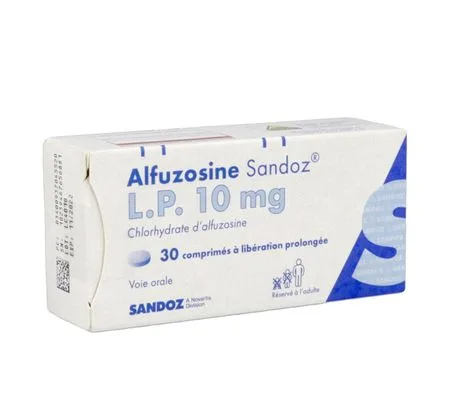
ALFUZOSIN SANDOZ L.P. 10 mg, prolonged-release tablet
Composition
Alfuzosin hydrochloride ............................................................................................................................10 mg
For one prolonged-release tablet.
Excipient with known effect: lactose.
Lactose monohydrate, hypromellose (E464), povidone K25, magnesium stearate.
Indications
• Treatment of the functional symptoms of benign prostatic hyperplasia,
• Adjuvant treatment to bladder catheterisation in acute urinary retention related to benign prostatic hyperplasia.
Dosage and administration
Dosage
Oral use.
The recommended dose is 1 tablet of 10 mg once daily, to be taken immediately after the evening meal.
Adjunctive treatment to bladder catheterisation in acute urinary retention related to benign prostatic hyperplasia:
The recommended dose is 1 tablet of 10 mg once daily, to be taken after a meal, starting from the first day of urethral catheterisation.
Treatment is administered for 3 to 4 days, including 2 to 3 days when the catheter is placed and 1 day after its removal.
Paediatric population
The efficacy of alfuzosin has not been demonstrated in children aged 2 to 16 years (see section Pharmacodynamics). Consequently, alfuzosin should not be used in the paediatric population.
Method of administration
The tablet must be swallowed whole with a glass of water (see section Warnings and precautions).
Contraindications
This product must not be administered in the following situations:
• hypersensitivity to alfuzosin or to any of the excipients listed in section Composition,
• orthostatic hypotension,
• hepatic insufficiency,
• severe renal impairment (creatinine clearance < 30 ml/min),
• combination with ombitasvir and paritaprevir (see section Interactions).
Warnings and precautions
Special warnings
This medicine should be used with caution in patients treated with antihypertensive medicines or nitrate derivatives.
Concomitant use of this medicine with alpha-blocking antihypertensives is not recommended (see section Interactions).
In some subjects, orthostatic hypotension may occur within hours of taking the medicine, possibly accompanied by symptoms (dizziness, fatigue, sweating). In this case, the patient must be kept in a lying position until the symptoms have completely disappeared.
These phenomena are usually transient, occur at the start of treatment and generally do not prevent continuation of treatment. A marked decrease in blood pressure has been reported during post-marketing surveillance in patients with pre-existing risk factors (such as underlying heart disease and/or concomitant treatment with antihypertensive medicines).
There is a risk of cerebral ischaemic events, particularly in elderly patients with pre-existing symptomatic cerebral circulatory disorders (such as cardiac arrhythmia, atrial fibrillation, history of transient ischaemic attack) or asymptomatic ones, due to the occurrence of hypotension after administration of alfuzosin (see section Adverse effects).
The patient must be informed of the possibility of these events occurring.
Caution is recommended, particularly in elderly subjects. Indeed, the risk of occurrence of hypotension and associated symptoms may be higher in elderly patients.
As with all alpha-1 blockers, this medicine should be used with caution in patients with acute heart failure.
Patients with congenital prolongation of the QTc interval, a history of QTc interval prolongation, or who are treated with medicines that prolong the QTc interval must be monitored before and during treatment.
The combination of alfuzosin and potent inhibitors of CYP3A4 (such as itraconazole, ketoconazole, protease inhibitors, clarithromycin, telithromycin and nefazodone) should be avoided (see section Interactions). Alfuzosin must not be used in combination with CYP3A4 inhibitors known to prolong the QTc interval (for example, itraconazole and clarithromycin), and if such treatment is initiated, it is recommended to temporarily discontinue alfuzosin.
Rare cases of priapism (prolonged painful erection not related to sexual activity) have been reported in patients treated with alfuzosin as well as with other alpha-1 blockers. Rapid management (sometimes surgical) of patients is essential. Indeed, priapism can lead to permanent impotence if not properly treated.
Intraoperative floppy iris syndrome (IFIS, a variant of small pupil syndrome) has been observed during cataract surgery in some patients currently or previously treated with tamsulosin. Isolated cases have also been reported with other alpha-1 blockers and a class effect cannot be excluded. Since IFIS may cause additional technical difficulties during cataract surgery, current or prior administration of alpha-1 blockers should be reported to the ophthalmic surgeon before surgery, even though the risk of IFIS with alfuzosin is low.
Given the absence of safety data in patients with severe renal impairment (creatinine clearance < 30 ml/min), ALFUZOSINE SANDOZ L.P. 10 mg, prolonged-release tablet should not be administered to these patients.
Precautions for use
Caution is recommended when alfuzosin is administered to patients who have had marked hypotension in response to administration of another alpha-1 blocker.
In patients with coronary artery disease, alfuzosin will not be prescribed alone. Specific treatment of coronary insufficiency will be continued. If angina reappears or worsens, alfuzosin treatment will be discontinued.
Use with PDE-5 inhibitors : concomitant administration of ALFUZOSINE SANDOZ L.P. 10 mg with a phosphodiesterase-5 inhibitor (for example sildenafil, tadalafil and vardenafil) may cause symptomatic hypotension in some patients (see section Interactions). In order to reduce the risk of orthostatic hypotension, patients should be stabilised on alpha-blocker treatment before initiating treatment with a phosphodiesterase-5 inhibitor. In addition, it is recommended to start phosphodiesterase-5 inhibitor treatment at the lowest possible dose.
Patients should be advised that the tablets must be swallowed whole. The tablets must not be chewed, crushed, or ground into powder. These actions may lead to inappropriate release and absorption of the medicine and consequently to adverse effects that may occur early.
This medicine contains lactose. Patients with galactose intolerance, total lactase deficiency or glucose-galactose malabsorption syndrome (rare hereditary diseases) must not take this medicine.
Interactions
Medicines causing orthostatic hypotension
Besides antihypertensives, many medicines may cause orthostatic hypotension. This is particularly the case for nitrates, phosphodiesterase type 5 inhibitors, alpha-blockers used for urological purposes, imipramine-type antidepressants and phenothiazine neuroleptics, dopamine agonists and levodopa.
Their concomitant use may therefore increase the frequency and intensity of this adverse effect. Refer to the interactions specific to each class, with the corresponding levels of constraint.
Contraindicated combinations
+ Ombitasvir + paritaprevir
Increase in plasma concentrations of alfuzosin due to decreased hepatic metabolism by the two-drug combination.
Combinations not recommended
+ Alpha-blocking antihypertensives (doxazosin, prazosin, urapidil)
Potentiation of the hypotensive effect. Risk of severe orthostatic hypotension.
+ Potent CYP3A4 inhibitors (boceprevir, clarithromycin, cobicistat, erythromycin, itraconazole, ketoconazole, nelfinavir, posaconazole, ritonavir, telaprevir, telithromycin, nefazodone, voriconazole)
Risk of increased plasma concentrations of alfuzosin and its adverse effects (see section Warnings and precautions).
Associations requiring precautions for use
+ Phosphodiesterase type 5 inhibitors (avanafil, sildenafil, tadalafil, vardenafil)
Risk of orthostatic hypotension, particularly in elderly subjects.
Start treatment at the minimum recommended doses and adjust doses progressively if needed.
Associations to be taken into account
+ Antihypertensives except alpha-blockers
Potentiation of the hypotensive effect. Risk of severe orthostatic hypotension.
+ Dapoxetine
Risk of increased adverse effects, particularly dizziness or syncope.
+ Medicines lowering blood pressure
Risk of increased hypotension, in particular orthostatic hypotension.
Fertility, pregnancy and breastfeeding
Pregnancy and breastfeeding
The therapeutic indication does not concern women.
The safety of alfuzosin during pregnancy and the passage of alfuzosin into breast milk are not known.
Driving and using machines
No data are available concerning the effect of alfuzosin on the ability to drive vehicles.
Particular caution should be exercised by drivers of vehicles and users of machinery due to the risks of orthostatic hypotension, dizziness, asthenia and visual disturbances, especially at the start of treatment with alfuzosin.
Adverse effects
Adverse effects are classified by frequency of occurrence using the following convention: very common (≥ 1/10), common (≥ 1/100, < 1/10), uncommon (≥ 1/1 000, <1/100), rare (≥ 1/10 000, < 1/1 000), very rare (< 1/10 000), frequency not known (cannot be estimated from the available data).
|
|
FREQUENCY |
|||
|
ORGAN SYSTEM |
Common (≥ 1 % - <10 %) |
Uncommon (≥ 0,1 % - <1 %) |
Very rare (< 0,01 %) |
Not determined |
|
Cardiac disorders |
|
Tachycardia, palpitations |
Angina pectoris in patients with a history of coronary disorders |
Atrial fibrillation |
|
Eye disorders |
|
|
|
Intraoperative floppy iris syndrome |
|
General disorders and administration site conditions |
Asthenia, malaise |
Oedema, chest pain |
|
|
|
Gastrointestinal disorders |
Nausea, abdominal pain |
Diarrhoea, dry mouth, vomiting |
|
|
|
Hepato-biliary disorders |
|
|
|
Hepatocellular damage, hepatic cholestasis |
|
Nervous system disorders |
Dizziness, light-headedness, headache |
Syncope, vertigo, somnolence |
|
Cerebral ischaemic events in patients with underlying cerebrovascular disorders |
|
Disorders of the reproductive system and breast |
|
|
|
Priapism |
|
Respiratory, thoracic and mediastinal disorders |
|
Nasal congestion |
|
|
|
Skin and subcutaneous tissue disorders |
|
Skin rash, pruritus |
Urticaria, angioedema |
|
|
Vascular disorders |
|
Orthostatic hypotension (see section Warnings and precautions), flushing |
|
|
|
Blood and lymphatic system disorders |
|
|
|
Neutropenia, thrombocytopenia |
Reporting of suspected adverse reactions
Reporting suspected adverse reactions after authorisation of the medicinal product is important. It allows continued monitoring of the benefit/risk balance of the medicinal product. Healthcare professionals are asked to report any suspected adverse reaction via the national reporting system: National Agency for the Safety of Medicines and Health Products (ANSM) and the network of Regional Centres of Pharmacovigilance - Website: https://signalement.social-sante.gouv.fr/.
Overdose
In case of overdose, the patient should be hospitalised and kept in a supine position.
Standard treatment of hypotension should be instituted.
In case of severe hypotension, a vasoconstrictor acting directly on the muscle fibres of the blood vessels may be used.
Due to its high protein binding, alfuzosin is difficult to dialyse.
Pharmacodynamics
Pharmacotherapeutic class: ALPHA-BLOCKERS, ATC code: G04CA01 - G: genito-urinary system and sex hormones.
Alfuzosin is a quinazoline derivative, active orally. It is a selective antagonist of post-synaptic alpha-1 adrenergic receptors. The pharmacology studies carried out in vitro confirmed the selectivity of alfuzosin for alpha-1 adrenergic receptors located in the prostate, the vesical trigone and the urethra.
Alpha blockers, through a direct action on the smooth muscle of prostatic tissue, reduce infra-vesical obstruction. The studies in vivo in animals showed that alfuzosin reduced urethral pressure and therefore resistance to urinary flow during micturition. A study in conscious rats showed an effect on urethral pressure of greater magnitude than the effect on arterial pressure.
In placebo-controlled studies in patients suffering from benign prostatic hyperplasia, alfuzosin:
• significantly increased urinary flow by an average of 30 % in patients with a flow rate ≤15 ml/s. This improvement is observed from the first dose,
• significantly decreased detrusor pressure and increased the volume causing the sensation of the need to urinate,
• significantly reduced residual urinary volume.
These effects lead to an improvement in irritative and obstructive urinary symptoms. They do not cause any harmful effect on sexual functions.
Furthermore, the maximum urinary flow rate remains significantly increased 24 hours after intake.
In the ALFAUR study, the effect of alfuzosin on micturition resumption was assessed in 357 men over 50 years of age, presenting a first painful episode of acute urinary retention (AUR) related to benign prostatic hyperplasia (BPH) with a post-void residual volume between 500 and 1500 ml at catheter insertion and during the first hour following it. In this multicentre, randomised, double-blind study, with two parallel groups, comparing 10 mg/day of prolonged-release alfuzosin with placebo, the assessment of micturition resumption was performed 24 hours after catheter removal, in the morning, after at least two days of alfuzosin treatment.
Treatment with alfuzosin significantly increased (p = 0,012) the rate of micturition resumption after catheter removal, in patients who had a first episode of AUR, i.e. 146 micturition resumptions (61,9 %) in the alfuzosin group versus 58 (47,9 %) in the placebo group.
Paediatric population
Alfuzosin must not be used in the paediatric population (see section Dosage and administration).
The efficacy of alfuzosin hydrochloride has not been demonstrated in 2 studies conducted in 197 patients aged 2 to 16 years with high detrusor leak point pressure (LPP ≥ 40 cm H2O) of neurogenic origin. Patients were treated with 0,1 mg/kg/day or 0,2 mg/kg/day of alfuzosin hydrochloride using adapted paediatric formulations.
Pharmacokinetics
Alfuzosin
The binding of alfuzosin hydrochloride to plasma proteins is approximately 90 %.
Alfuzosin undergoes extensive metabolism by the liver, with only 11 % of the unchanged compound excreted in the urine.
Most metabolites (which are inactive) are excreted in the faeces (75 to 90 %).
The pharmacokinetic profile of alfuzosin is not modified in cases of chronic heart failure.
Prolonged-release formulation
The mean value of relative bioavailability is 104,4 % after administration of a 10 mg dose, compared with that of the immediate-release formulation at a dosage of 7,5 mg (2,5 mg 3 times a day), in healthy middle-aged volunteers. The maximum plasma concentration is reached 9 hours after administration versus 1 hour for the immediate-release formulation.
The apparent elimination half-life is 9,1 hours.
Studies have shown that bioavailability is increased when the product is administered after a meal (see section Dosage and administration).
The pharmacokinetic parameters (Cmax and AUC) are not increased in elderly patients compared with healthy middle-aged volunteers.
The mean values of Cmax and SSC are moderately increased in patients with moderate renal impairment (creatinine clearance >30 ml/min), without change in elimination half-life, compared with patients with normal renal function.
Dose adjustment is therefore not necessary in renally impaired patients with creatinine clearance >30 ml/min.
Special storage precautions
Store the blisters in the outer packaging, protected from light.
Store at a temperature not exceeding 25°C.
Prescription, supply and reimbursement
| Marketing authorisation (AMM) |
|
| Price: |
|
- Benign prostatic hypertrophy
Collection.
9 PLACE MARIE-JEANNE BASSOT
92300 LEVALLOIS-PERRET
Tel: 01 49 64 48 00 Tel (Green number): 0800 455 799
serviceclient.pharmacie@sc-sandoz.com
https://www.sandoz.fr/contactez-nous/
Source: VIDAL · Updated on 10/11/2026. This information does not replace advice from a healthcare professional.