
Medicines
SmPC of the 02/08/2024
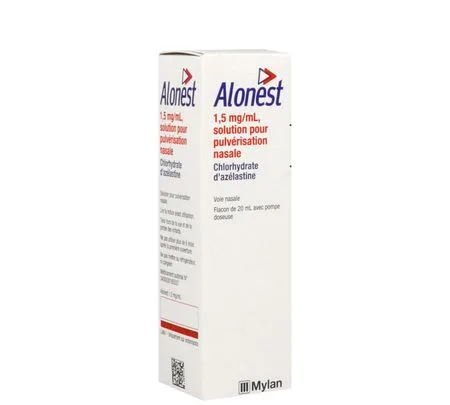
ALONEST 1,5 mg/mL, nasal spray solution
Composition
Solution containing 1,5 mg/mL of azelastine hydrochloride.
For 1 dose of 0,14 mL of solution :
Azelastine hydrochloride: 0,2100 mg
Corresponding quantity of azelastine base: 0,1900 mg
Excipients with known effect: sorbitol, sodium citrate.
Hypromellose, sucralose (E 955), liquid sorbitol (crystallising), disodium edetate, sodium citrate, purified water.
Indications
Symptomatic treatment of allergic rhinitis for adults, adolescents and children aged 6 years and older.
Dosage and administration
Dosage
ALONEST 1,5 mg/mL, nasal spray solution is suitable for long-term use. The duration of treatment depends on the severity of symptoms, the safety and the duration of exposure to the allergen.
Adults and adolescents aged 12 years and older:
2 sprays in each nostril, once a day. In some cases, 2 sprays in each nostril, 2 times a day may be necessary. The maximum recommended daily dose is 2 sprays in each nostril, 2 times a day.
Paediatric population:
Children aged 6 to 11 years:
1 spray in each nostril 2 times a day.
The efficacy and safety after 4 weeks of administration in children older than 6 years have been demonstrated in a clinical trial. No data are available beyond 4 weeks of administration in children older than 6 years; however, clinical trials lasting up to one year using a daily dose twice as high have shown the safety of ALONEST 1,5 mg/mL, nasal spray solution in adults and adolescents.
This medicine must not be used in children under 6 years of age due to the absence of safety and/or efficacy data.
Use for a duration longer than 4 weeks is not recommended in children aged 6 to 11 years due to the absence of clinical data.
Method of administration
Nasal route (topical administration - nasal mucosa)
Precautions to take before handling or administering the medicine:
Keep the head upright during administration.
Before first use, prime the pump by pressing six times. When ALONEST 1,5 mg/mL, nasal spray solution has not been used for 3 days or more, the pump must be primed again to obtain a regular spray.
Contraindications
Hypersensitivity to the active substance, azelastine hydrochloride, or to any of the excipients listed in section Composition.
Interactions
No interaction studies have been performed.
Interaction studies at high oral doses have been conducted. Nevertheless, their results have no consequence for ALONEST 1,5 mg/mL, nasal spray solution since the systemic level after nasal administration remains below the 1/5 of the well-tolerated level after oral administration.
Fertility, pregnancy and breastfeeding
Pregnancy
There is no or only limited information on the use of azelastine in pregnant women. At high oral doses in animals, toxic effects on reproduction have been observed (see section ). Therefore, caution is required when using this medicine during pregnancy. Preclinical safety). Therefore, caution is required when using this medicine during pregnancy.
Breast-feeding
It is not known whether azelastine or its metabolites are excreted in human milk. As many medicines are excreted in human milk, caution is required when administering ALONEST 1,5 mg/mL, nasal spray solution to breastfeeding women.
Fertility
Effects on fertility have been observed in animal studies (see section Preclinical safety).
Driving and using machines
ALONEST 1,5 mg/mL, nasal spray solution has a minor influence on the ability to drive and use machines.
Rarely, the following symptoms may occur: drowsiness, fatigue, exhaustion, dizziness or weakness due to the disease itself or to the administration of ALONEST 1,5 mg/mL, nasal spray solution. In these cases, the ability to drive and use machines may be impaired. Patients will be advised that alcohol may increase these effects.
Adverse effects
Dysgeusia (bitter taste) may commonly be experienced after administration (most often due to an inadequate method of administration, such as tilting the head too far back during administration), which may, in rare cases, cause nausea.
Undesirable effects are listed below by system organ class and grouped by frequency:
- Very common (≥ 1/10);
- Common (≥ 1/100 to < 1/10);
- Uncommon (≥ 1/1 000 to < 1/100);
- Rare (≥ 1/10 000 to < 1/1 000);
- Very rare (< 1/10 000);
- Frequency not determinable (cannot be estimated from the available data).
|
Immune system disorders |
Very rare |
Hypersensitivity |
|
Nervous system disorders |
Common |
Dysgeusia (bitter taste) |
|
Rare |
Dizziness*, drowsiness (sleepiness, feeling of wanting to sleep) |
|
|
Respiratory, thoracic and mediastinal disorders |
Uncommon |
Nasal discomfort (sensation of tingling and itching)
|
|
Gastrointestinal disorders |
Rare |
Nausea |
|
General disorders |
Rare |
Somnolence* (lassitude, exhaustion)
|
|
Skin and subcutaneous tissue disorders |
Very rare |
Rash
|
* may also be caused by the disease itself (see section Driving and using machines)
Reporting of suspected adverse reactions
Reporting suspected adverse reactions after authorisation of the medicinal product is important. It allows continued monitoring of the benefit/risk balance of the medicinal product. Healthcare professionals are asked to report any suspected adverse reaction via the national reporting system: National Agency for the Safety of Medicines and Health Products (ANSM) and the network of Regional Centres of Pharmacovigilance - Website: https://signalement.social-sante.gouv.fr/ .
Overdose
Overdose incidents after nasal administration are very unlikely. Results from animal studies have shown that in case of accidental oral overdose, neurological disorders (drowsiness, confusion, coma, tachycardia and hypotension) may occur. Symptomatic treatment should be initiated. Gastric lavage is recommended depending on the amount swallowed. There is no specific antidote.
Pharmacodynamics
Pharmacotherapeutic class: decongestants and other nasal preparations for topical use, antihistamines, excluding corticosteroids, ATC code: R01AC03.
Mechanism of action
Azelastine, a phthalazinone derivative, is a potent, long-acting anti-allergic agent with anti-H1 properties. Azelastine is also anti-inflammatory following topical ocular administration.
Clinical efficacy and safety
In vivo (preclinical) and in vitro study data show that azelastine inhibits the synthesis or release of chemical mediators involved at both early and late stages of allergic reactions, i.e. leukotrienes, histamine, PAF, serotonin.
Clinical study data show that azelastine nasal spray solution has a faster onset of action than desloratadine and mometasone administered nasally. Relief of allergic symptoms is observed within 15 minutes following administration.
Pharmacokinetics
Absorption
After oral administration, azelastine is rapidly absorbed. Absolute bioavailability is 81 %. Food does not interfere with absorption. The volume of distribution is high, indicating preferential distribution to peripheral tissues. Protein binding is relatively low (i.e. 80 %-90 %, a level too low to cause displacement interactions).
Elimination
Plasma elimination half-lives after single administration of azelastine are approximately 20 hours for azelastine and 45 hours for N-desmethylazelastine (active metabolite). Elimination is mainly fecal. Prolonged fecal excretion of small amounts of the administered dose suggests the existence of enterohepatic recycling.
Linearity/non-linearity
After nasal administration of 2 sprays in each nostril (0,822 mg total dose) of ALONEST 1,5 mg/mL, nasal spray solution, the mean peak plasma concentration of azelastine is 409 pg/mL (Cmax) in healthy subjects, the mean systemic exposure (AUC) is 9 312 pg*hr/mL, and the median time to reach Cmax (tmax) is 4 hours.
Preclinical safety
Azelastine hydrochloride shows no sensitization phenomenon in guinea pigs. No genotoxic potential has been observed in in vitro and in vivo tests for azelastine, nor any carcinogenic potential in rats or mice. In male and female rats, azelastine at oral doses above 3,0 mg/kg/day caused a dose-related decrease in fertility index; no substance-related changes were observed in the reproductive organs of males or females during repeated-dose toxicity studies.
Embryotoxic and teratogenic effects in rats, mice and rabbits were observed only at maternally toxic doses (for example in mice and rats, at levels of 68,6 mg/kg/day). At high oral doses in animals, 1095 times higher than the maximum recommended daily nasal dose in humans, fetal death, growth retardation and increased frequency of skeletal abnormalities were observed during reproductive toxicity tests.
Prescription, supply and reimbursement
| Marketing authorisation (AMM) |
|
| Price: |
|
- Indication(s) appearing in the marketing authorisation at the date of publication of this decree
Collection.
1 RUE DE TURIN
69007 LYON
Tel: 04 37 25 75 00 https://www.viatris.fr/
Source: VIDAL · Updated on 10/11/2026. This information does not replace advice from a healthcare professional.