
Medicines
SmPC of 26/11/2025
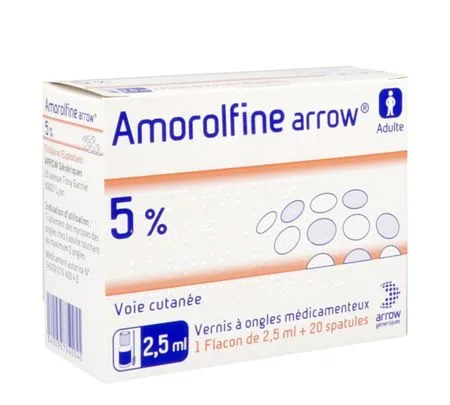
AMOROLFINE ARROW 5 %, medicated nail lacquer
Composition
Amorolfine hydrochloride............................................................................................................................5,57 g
Quantity corresponding to amorolfine base...............................................................................................5,00 g
For 100 mL
Excipient with known effect: ethanol.
Methacrylic acid copolymer, triacetin, butyl acetate, ethyl acetate, absolute ethanol.
Dosage and administration
Dosage
Apply AMOROLFINE ARROW to the affected nails at a dose of once or twice per week.
Method of administration
To apply the lacquer, carefully follow the recommendations below:
For packs without accessories
a) Before the first application of AMOROLFINE ARROW, carefully clean the nails and file the affected area of the nail (in particular the nail surface) as completely as possible with a nail file.
Take care not to file the periungual skin.
b) Clean the nail surface and degrease it using a compress or a cloth soaked in solvent.
c) Apply the lacquer using one of the reusable spatulas over the entire affected nail. Clean the reusable spatula between each nail to avoid contaminating the lacquer. Do not wipe the spatula on the rim of the bottle.
d) It is important to thoroughly clean the spatula using a compress or a cloth soaked in solvent after each application, before reusing it on another nail, to avoid contaminating the lacquer.
e) If lacquer has been deposited on the outside of the stopper during handling, it is important to clean it using a compress or a cloth soaked in solvent, to avoid applying this lacquer to the skin.
f) Reseal the bottle tightly.
Repeat all of the above steps for each affected nail.
Cosmetic nail varnishes may be applied at least 10 minutes after application of AMOROLFINE ARROW.
Treatment must be continued without interruption until complete regeneration of the nail and clinical and mycological cure of the affected areas.
The duration of treatment is generally 6 months for fingernails and 9 months for toenails (it depends essentially on the severity and location of the infection and the extent of nail involvement).
Special instructions
Do not reuse nail files on healthy nails.
Before each new application, file the affected nails if necessary and in all cases clean them using nail polish remover to remove residual varnish.
When handling organic solvents (white spirit, thinners…), it is necessary to wear waterproof gloves to protect the AMOROLFINE ARROW varnish layer on the nails.
For packs with accessories
a) Before the first application of AMOROLFINE ARROW, carefully clean the nails and file the affected area of the nail (in particular the nail surface) as completely as possible with a nail file.
Take care not to file the periungual skin.
b) Clean the nail surface and degrease it using one of the cleaning wipes provided, in order to remove any trace of residual varnish.
c) Apply the lacquer using one of the reusable spatulas over the entire affected nail. Clean the reusable spatula between each nail to avoid contaminating the lacquer. Do not wipe the spatula on the rim of the bottle.
d) It is important to thoroughly clean the spatula using one of the cleaning wipes provided after each application, before reusing it for another nail, in order to avoid contamination of the varnish.
e) If varnish has been deposited on the outside of the cap during handling, it is important to clean it using one of the cleaning wipes provided in order to avoid applying this varnish to the skin.
f) Reseal the bottle tightly.
Repeat all of the above steps for each affected nail.
Cosmetic nail varnishes may be applied at least 10 minutes after application of AMOROLFINE ARROW.
Treatment must be continued without interruption until complete regeneration of the nail and clinical and mycological cure of the affected areas.
The duration of treatment is generally 6 months for fingernails and 9 months for toenails (it depends essentially on the severity and location of the infection and the extent of nail involvement).
Special instructions
Do not reuse nail files on healthy nails.
Before each new application, file the affected nails if necessary and in all cases clean them using the cleaning wipes to remove residual varnish.
When handling organic solvents (white spirit, thinners…), it is necessary to wear waterproof gloves to protect the AMOROLFINE ARROW varnish layer on the nails.
Contraindications
Hypersensitivity to the active substance or to any of the excipients listed in section Composition.
Warnings and precautions
Avoid any contact of AMOROLFINE ARROW with the eyes, ears or mucous membranes.
AMOROLFINE ARROW should be used with caution in patients with conditions predisposing to nail disorders (peripheral circulatory disorders, diabetes, diseases of the immune system) as well as in patients with nail dystrophy or severely damaged nails (more than two thirds of the nail plate is affected). In these cases a systemic treatment should be considered.
Do not use artificial nails during treatment with AMOROLFINE ARROW.
If organic solvents are handled, waterproof gloves must be worn, otherwise the varnish will be dissolved.
After application of AMOROLFINE ARROW, a period of at least 10 minutes must be observed before applying cosmetic nail varnish. Before repeating the application of AMOROLFINE ARROW, cosmetic nail varnish must be thoroughly removed.
A systemic or local allergic reaction could possibly occur after use of this medicine. If this happens, the medicine must be stopped immediately and a doctor must be consulted. Carefully remove the product using nail polish remover. The medicine must not be reused.
Paediatric population
In the absence of data, the use of AMOROLFINE ARROW is not recommended in patients under 18 years of age.
Excipient with known effect
This medicine contains 1,20 g of alcohol (ethanol) per 2,5 mL bottle. This may cause a burning sensation on damaged skin. Ethanol is a flammable substance and must not be used near a flame, a lit cigarette or certain appliances (for example hair dryers).
Interactions
The data available to date do not suggest the existence of clinically significant interactions.
Fertility, pregnancy and breastfeeding
There are limited data on the use of amorolfine in pregnant and breast-feeding women. Only a small number of pregnancies exposed to topical amorolfine have been reported after marketing, so the potential risk is unknown.
Studies carried out in animals have shown reproductive toxicity at high oral doses (see section Preclinical safety).
It is not known whether amorolfine is excreted in human milk.
AMOROLFINE ARROW must not be used during pregnancy and breast-feeding, except in cases of real necessity.
Adverse effects
|
System Organ Class |
Frequency |
Adverse effects |
|
Immune system disorders |
Frequency not determined (cannot be estimated from the available data) |
Hypersensitivity (systemic allergic reaction)* |
|
Skin and subcutaneous tissue disorders |
Rare (> 1/10 000, < 1/1 000) |
Nail abnormality, nail discolouration, brittle nails (onychoclasis), fragile nails (onychorrhexis) |
|
Very rare (< 1/10 000)
|
Sensation of skin burning |
|
|
Frequency not determined (cannot be estimated from the available data) |
Erythema, pruritus, contact dermatitis, urticaria, blister |
* Adverse effect reported since marketing.
Reporting of suspected adverse reactions
Reporting suspected adverse reactions after authorisation of the medicinal product is important. It allows continued monitoring of the benefit/risk balance of the medicinal product. Healthcare professionals are asked to report any suspected adverse reaction via the national reporting system: National Agency for the Safety of Medicines and Health Products (ANSM) and the network of Regional Centres of Pharmacovigilance - Website: https://signalement.social-sante.gouv.fr/.
Overdose
No systemic signs of overdose are expected after topical application of AMOROLFINE ARROW.
In case of accidental ingestion, appropriate symptomatic measures should be taken.
Pharmacodynamics
Pharmacotherapeutic class: other antifungals for topical use, ATC code: D01AE16.
AMOROLFINE ARROW is a topical antimycotic. The active ingredient, amorolfine, derived from morpholine, belongs to a new chemical class of antimycotics.
Its fungistatic and fungicidal effect is based on an alteration of the fungal cell membrane, mainly targeting sterol biosynthesis.
The ergosterol content is reduced. An accumulation of atypical sterols leads to morphological changes in cell membranes and organelles that cause the death of the fungal cell.
Amorolfine has a broad antimycotic spectrum. It is very effective against the usual or occasional agents of onychomycosis:
• yeasts:
- Candida albicans and other species of Candida;
• dermatophytes:
- Trichophyton rubrum, Trichophyton interdigitale and Trichophyton mentagrophytes, other species of Trichophyton ;
- Epidermophyton floccosum;
- Microsporum;
• moulds:
- Scopulariopsis;
• dematiaceous (black fungi):
- Hendersonula, Alternaria, Cladosporium;
• species with low sensitivity:
- Aspergillus, Fusarium, Mucorales.
Pharmacokinetics
Amorolfine in the form of a nail lacquer penetrates and diffuses through the nail plate and is able to eradicate fungi that are less accessible in the nail bed.
The general absorption of the active ingredient is negligible, with the plasma concentration remaining below the sensitivity threshold, even after one year of use.
Preclinical safety
In rats, amorolfine is not teratogenic and is not embryotoxic at the maximum oral dose tested of 40 and 80 mg/kg/day. However, signs of maternal toxicity (weight loss) were observed at doses of 40 and 80 mg/kg/day.
In rabbits, amorolfine is not teratogenic but has an embryotoxic effect at the maximum oral dose tested of 10 mg/kg/day. Maternal weight loss, reflecting maternal toxicity, was also observed at the dose of 10 mg/kg/day.
Due to the very low systemic absorption of amorolfine following application to the nail or skin, the potential risk of toxicity to the human fetus is negligible.
Prescription, supply and reimbursement
| Marketing authorisation (AMM) |
|
| Price: |
|
- Indication(s) appearing in the marketing authorization (AMM) as of the publication date of this order (1Fl/2,5ml+20spat)
Not reimbursed by Social Security (1Fl/2,5ml+30spat).
Collect (1Fl/2,5ml+20spat).
26 AVENUE TONY GARNIER
69007 LYON
Tel: 04 72 72 60 72 Tel (toll-free): 0811 65 27 76
contact@laboratoire-arrow.com
http://www.laboratoire-arrow.com/
Source: VIDAL · Updated on 10/11/2026. This information does not replace advice from a healthcare professional.