
Medicines
SmPC of 15/09/2022
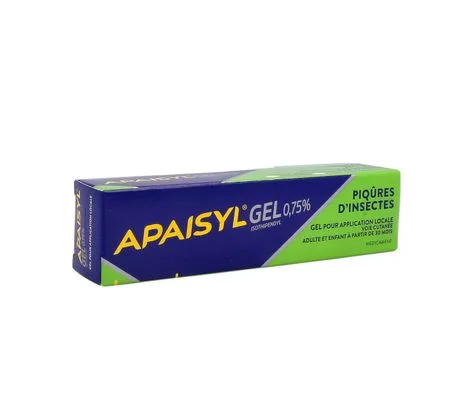
APAISYLGEL 0,75 %, gel for cutaneous application
Composition
Isothipendyl hydrochloride ......................................................................................................................0,750 g
For 100 g of gel for cutaneous application.
Excipient with known effect : sorbic acid (E200).
Edetic acid, sorbic acid, sorbitol at 70 percent non-crystallisable, sodium carboxymethylcellulose, sodium hydroxide, purified water.
Dosage and administration
Dosage
Reserved for adults and children over 2 years.
1 application 2 to 3 times per day.
Do not exceed 5 days of treatment without medical advice.
Paediatric population
The safety and efficacy of APAISYLGEL 0,75 %, gel for cutaneous application in children under 2 years have not been established.
No data are available.
Method of administration
Cutaneous route
Apply only to the insect bite without spreading onto healthy skin.
Wash hands after use.
Contraindications
- Hypersensitivity to the active substance or to any of the excipients listed in section Composition
- History of allergy to antihistamines,
- Infected or irritated dermatoses
- Weeping lesions
- Eczema
Warnings and precautions
Special warnings
- Pruritus is only a symptom. It always requires investigation and treatment of its aetiology.
- Persistence or worsening of pruritus may be related to an allergy to one of the components of the preparation.
- Given the presence of isothipendyl hydrochloride, there is a risk of cutaneous sensitisation and photosensitisation. In case of proven cutaneous sensitisation to isothipendyl hydrochloride contained in the gel, cross-sensitisation may occur after systemic administration of phenothiazines.
- Also, persistence or worsening of pruritus may be linked to an allergy to isothipendyl hydrochloride or to one of the components of this medicine.
- The development of an allergy to isothipendyl hydrochloride may in future contraindicate certain medicines used systemically (certain local anaesthetics, certain antihistamines).
- Do not apply over a large area, under an occlusive dressing, or on damaged skin, due to the risk of the active ingredient passing into the blood.
- Do not apply to mucous membranes.
- In the absence of data on cutaneous absorption, the risk of systemic effects cannot be excluded. This risk is all the more to be feared when the topical product is used over a large area, under an occlusive dressing, on damaged skin (in particular burned skin), or on a mucous membrane.
- This medicine contains sorbic acid (E200) and may cause local skin reactions (for example: contact dermatitis).
Precautions for use
Given the photosensitising effect of phenothiazines, it is preferable not to expose oneself to the sun or to UVA during treatment.
It is recommended to protect the treated areas by wearing clothing throughout the duration of treatment in order to avoid any risk of photosensitisation.
This medicine is not a sunscreen.
Do not apply to extensive areas of the body.
This medicine must not be used as a skincare cream on healthy skin.
Interactions
At the recommended doses, isothipendyl hydrochloride for topical use is not likely to cause medically significant drug interactions.
Fertility, pregnancy and breastfeeding
To be used with caution in pregnant or breastfeeding women because of the anticholinergic properties of isothipendyl hydrochloride. Do not apply to the breasts during breastfeeding.
Adverse effects
Risk of sensitisation to isothipendyl or to another component. Reactions are generally cutaneous and localised to the site of application.
Very rare cases of photosensitisation have been reported.
Very rare cases of generalised hypersensitivity reactions have been reported.
Reporting of suspected adverse reactions
Reporting suspected adverse reactions after authorisation of the medicinal product is important. It allows continued monitoring of the benefit/risk balance of the medicinal product. Healthcare professionals are asked to report any suspected adverse reaction via the national reporting system: National Agency for the Safety of Medicines and Health Products (ANSM) and the network of Regional Centres of Pharmacovigilance - Website: www.signalement-sante.gouv.fr.
Overdose
Signs of phenothiazine overdose: convulsions (especially in infants and children), impaired consciousness, coma. Symptomatic treatment will be instituted in a specialised setting.
Pharmacodynamics
Pharmacotherapeutic class: ANTI-PRURITIC, INCLUDING ANTIHISTAMINES, ANAESTHETICS, Antihistamine for topical use.
ATC code: D04AA22.
Isothipendyl hydrochloride, of the aliphatic side-chain phenothiazine class, is an H1 antihistamine neuroleptic, anticholinergic, adrenolytic and antidopaminergic agent.
Antihistamines share the property of opposing, by more or less reversible competitive antagonism, the effects of histamine, notably on the skin, blood vessels and conjunctival, nasal, bronchial and intestinal mucous membranes.
Pharmacokinetics
There are no pharmacokinetic data on the topical use of isothipendyl hydrochloride.
Isothipendyl hydrochloride belongs to the phenothiazine class, whose maximum plasma concentration after oral absorption is reached in approximately 1 hour. After a significant hepatic first-pass effect, excretion occurs mainly via the urine.
By analogy with phenothiazines of similar structure and similar pharmacological behaviour, systemic absorption of isothipendyl hydrochloride may occur following its topical application to the treated area.
SPECIAL PRECAUTIONS FOR DISPOSAL AND OTHER HANDLING
No special requirements. Any unused medicinal product or waste must be disposed of in accordance with local regulations in force.
Prescription, supply and reimbursement
| Marketing authorisation (AMM) |
|
163-165 QUAI AULAGNIER
92600 ASNIERES-SUR-SEINE CEDEX
Tél : 01 40 88 50 00 https://fr.pg.com/
Source: VIDAL · Updated on 10/11/2026. This information does not replace advice from a healthcare professional.