
Medicines
SmPC of 12/01/2024
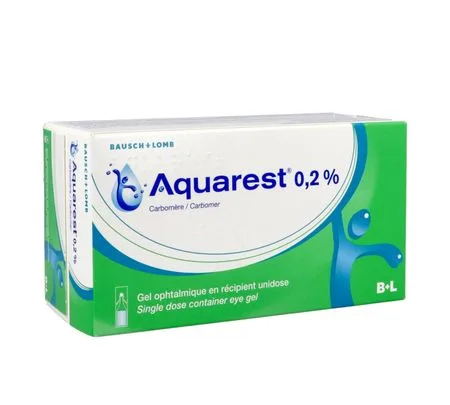
AQUAREST 0,2%, ophthalmic gel in unit-dose container
Composition
Carbomer........................................................................................................................................................2 mg
Per 1 g of ophthalmic gel
1 g of ophthalmic gel contains 2 mg of carbomer (viscosity 40 000-60 000 mPa.s).
Excipient with known effect:
AQUAREST 0,2%, ophthalmic gel in unit-dose container contains 0,00831 mg of phosphates in each drop, which is equivalent to 1 mg/g.
Sorbitol
Medium-chain triglycerides
Disodium phosphate dodecahydrate
Sodium hydroxide
Water for injections.
Dosage and administration
Dosage
Treatment of dry eye syndrome requires an individualised dosage.
Depending on the severity and intensity of the symptoms, instil one drop into the conjunctival sac 3 to 5 times daily, or more frequently if necessary, and at bedtime.
Take care to administer small drops by gently squeezing the unit-dose container and holding it vertically.
Avoid contact of the unit-dose container with the eye and eyelids.
Consult an ophthalmologist if treatment of dry eye is long-term or permanent. If symptoms of dry eye persist or worsen, stop using this medicine and consult your doctor.
Method of administration
Ophthalmic use.
Paediatric population
The safety and efficacy of AQUAREST 0,2%, ophthalmic gel in unit-dose container in children and adolescents, at the recommended adult dosage, have been established by clinical experience, but no clinical trial data are available.
Contraindications
Hypersensitivity to the active substance or to any of the excipients listed in section Composition.
Warnings and precautions
Contact lens wearers must remove their lenses before instilling AQUAREST 0,2%, ophthalmic gel in unit-dose container, and wait 15 minutes before reinserting them.
Interactions
No known interactions.
Note:
If you use AQUAREST 0,2%, ophthalmic gel in single-dose container at the same time as other eye drops, leave an interval of 15 minutes between applications.
If you use AQUAREST 0,2%, ophthalmic gel in single-dose container at the same time as other eye ointments, leave an interval of 15 minutes between applications.
AQUAREST 0,2%, ophthalmic gel in single-dose container may prolong the persistence of other eye drops and thus increase their action. To avoid this, AQUAREST 0,2%, ophthalmic gel in single-dose container must always be the last medicine to be applied.
Fertility, pregnancy and breastfeeding
Fertility
Regarding carbomer, no data on fertility are available. However, systemic exposure following use of AQUAREST 0,2%, ophthalmic gel in single-dose container is assumed to be low and effects on fertility are unlikely.
Pregnancy
For AQUAREST 0,2%, ophthalmic gel in single-dose container, no clinical data on use during pregnancy are available. Carbomer is probably absorbed only in small proportion and systemic exposure is therefore assumed to be low.
Breast-feeding
No effect on breastfed infants is expected given the low systemic exposure to carbomer in breastfeeding women. AQUAREST 0,2%, ophthalmic gel in single-dose container may be used during breastfeeding.
As a general rule, this medicine should not be used during pregnancy or breastfeeding, unless a doctor has carefully considered all potential risks and benefits.
Driving and using machines
AQUAREST 0,2%, ophthalmic gel in single-dose container has a minor to moderate influence on the ability to drive and use machines during the 5 minutes following instillation. Blurred vision, due to the formation of streaks lasting a few minutes, may appear after instillation of this gel into the conjunctival sac. Consequently, patients must not use machines, work outside safe conditions or drive vehicles during this period.
Adverse effects
Undesirable effects are categorised by frequency as follows:
• Very common (≥ 1/10)
• Common (≥ 1/100 to < 1/10)
• Uncommon (≥ 1/1 000 and < 1/100)
• Rare (≥ 1/10 000 and < 1/1 000)
• Very rare (< 1/10 000)
• Frequency not known (cannot be estimated from the available data)
|
Immune system disorders |
|
|
Very rare (< 1/10 000) |
Intolerance reactions to one of the components of this medicine. |
|
Eye disorders |
|
|
Frequency not known |
As with all eye preparations, blurred vision may occur shortly after instillation. |
|
Frequency not known |
Other reactions such as itching and burning have been observed in studies with comparable products. |
|
Very rare (< 1/10 000) |
A few very rare cases of corneal calcification have been reported in association with the use of drops containing phosphates in some patients with severely damaged corneas. |
Reporting of suspected adverse reactions
Reporting suspected adverse reactions after marketing authorisation of the medicinal product is important. It allows continuous monitoring of the benefit/risk balance of the medicinal product. Healthcare professionals report any suspected adverse reaction via the national reporting system: National Agency for the Safety of Medicines and Health Products (ANSM) and network of Regional Pharmacovigilance Centres - Website https://signalement.social-sante.gouv.fr/.
Overdose
No cases of overdose have been reported.
Any ocular overdose or oral intake that may occur has no clinical consequence.
Pharmacodynamics
Pharmacotherapeutic class: Ophthalmological agent, artificial tears, ATC code: S01XA.
The active substance carbomer forms a hydrophilic film that adheres to the ocular surface. It binds to water molecules and stabilises the tear film.
Pharmacokinetics
In pharmacokinetic studies, radioactive carbomer was administered to rats. It was demonstrated that only a small amount of carbomer is absorbed. After a single administration, 0,75 % of the administered dose was detected as carbon dioxide in exhaled air, and 0,63 % in urine. The majority of the carbomer (92 %) was detected in faeces 24 h after intake.
Due to the macromolecular structure of carbomer, it is considered that this proportion is eliminated without being metabolised, i.e. it does not enter the enterohepatic circulation.
Preclinical safety
Non-clinical data for the carbomer used in AQUAREST 0,2%, ophthalmic gel in single-dose container, as well as identical polyacrylic acids, reveal no particular risk in humans, based on conventional studies of subacute and chronic toxicity, genotoxicity, reproductive toxicity and local tolerance. No ocular irritation was observed in acute toxicity studies in rabbits and dogs following single and repeated doses of AQUAREST 0,2%, ophthalmic gel in single-dose container.
Shelf life
Unopened containers of this gel have a shelf life of 2 years.
AQUAREST 0,2%, ophthalmic gel in single-dose container does not contain a preservative.
Do not store a single-dose container that has already been opened.
Discard any unused content of the single-dose container after application.
Special storage precautions
Store at a temperature not exceeding 25°C.
Store in the original outer packaging, protected from light.
SPECIAL PRECAUTIONS FOR DISPOSAL AND OTHER HANDLING
Any unused medicinal product or waste material should be disposed of in accordance with local requirements.
For single use only.
Prescription, supply and reimbursement
| Marketing authorisation (AMM) |
|
| Price: |
|
Collection.
416 RUE SAMUEL MORSE CS 99535
34961 MONTPELLIER CEDEX 2
Tel: 04 67 12 30 30 https://www.bausch.com/
Source: VIDAL · Updated on 10/11/2026. This information does not replace advice from a healthcare professional.