
Medicines
SmPC of 13/08/2025
ARTANE 0,4 PER CENT, oral drops solution
Forms and presentations
Oral drops solution.
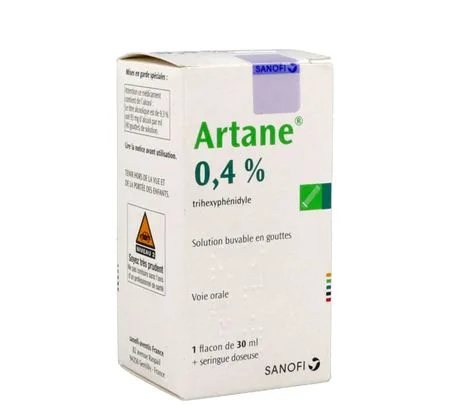
30 ml bottle, fitted with a child-resistant cap, with an oral dosing syringe graduated in drops.
Composition
For 100 ml:
Trihexyphenidyl hydrochloride: 0,400 g
Alcohol content of the solution: 9,55 % (w/v).
Excipients with known effect:
- Ethanol: 95,5 mg per ml (40 drops), i.e. 119,4 mg per dose of 50 drops of oral solution (corresponding to 5 mg of trihexyphenidyl hydrochloride),
- Sucrose: 350 mg per ml (40 drops), i.e. 437,5 mg per dose of 50 drops of oral solution (corresponding to 5 mg of trihexyphenidyl hydrochloride),
- Methyl parahydroxybenzoate: 0,55 mg per ml (40 drops), i.e. 0,68 mg per dose of 50 drops of oral solution (corresponding to 5 mg of trihexyphenidyl hydrochloride),
- Propyl parahydroxybenzoate: 0,11 mg per ml (40 drops), i.e. 0,13 mg per dose of 50 drops of oral solution (corresponding to 5 mg of trihexyphenidyl hydrochloride).
Ethanol at 96 per cent, sweet orange essential oil, sucrose, methyl parahydroxybenzoate, propyl parahydroxybenzoate, glycerol, purified water.
Dosage and administration
Dosage
Parkinson's disease :
4 to 10 mg per day, i.e. 40 to 100 drops per day in 2 or 3 doses.
Extrapyramidal syndromes due to neuroleptics:
Adults: 4 to 15 mg per day in 2 to 3 doses
Children: 2 to 6 mg per day depending on age in 2 to 3 doses.
In elderly patients :
Do not exceed 10 mg per day in 2 doses.
Method of administration
Oral use. This medicine must be administered only using the oral dosing syringe supplied with the bottle in the carton.
To measure, bring the liquid up to the required graduation mark.
The dosing syringe, graduated from 5 drops to 5 drops, must not be used either to count drops one by one or to administer other medicinal solutions.
Rinse with cold water after each use.
Contraindications
- Hypersensitivity to the active substance or to any of the excipients listed in section Composition,
- Glaucoma,
- Prostatic adenoma and particular sensitivity to anticholinergics,
- Decompensated cardiopathy.
Warnings and precautions
Special warnings
Psychiatric disturbances may result from the injudicious use of ARTANE 0,4 PER CENT, oral solution in drops, used with the aim of obtaining a euphoric state.
This medicine contains 95,5 mg of ethanol per ml (40 drops), i.e. 119,4 mg per dose of 5 mg of trihexyphenidyl hydrochloride (50 drops of oral solution), equivalent to 9,55 % w/v. The amount of ethanol in a dose of 5 mg of trihexyphenidyl hydrochloride is equivalent to less than 3 ml of beer or less than 2 ml of wine. The small amount of ethanol contained in this medicine is not likely to produce any noticeable effect.
This medicine contains sucrose. Patients with fructose intolerance, glucose-galactose malabsorption syndrome or sucrase/isomaltase insufficiency (rare hereditary diseases) must not take this medicine. This medicine may be harmful to the teeth.
This medicine contains methyl parahydroxybenzoate and propyl parahydroxybenzoate and may cause allergic reactions (possibly delayed).
Precautions for use
In elderly subjects, who may be more sensitive to the action of parasympatholytic substances, adjust the dosage very precisely.
Caution is required when administering the substance to patients suffering from obstructive diseases of the intestine and urinary tract.
Risk of worsening of intellectual deterioration in dementias, in particular in parkinsonian patients.
If the patient shows signs of intolerance, reduce the doses or temporarily suspend treatment.
Abrupt interruption of anticholinergic treatment may carry risks and should be avoided.
This medicine containing alcohol is not recommended in pregnant women.
It is recommended to use another pharmaceutical form not containing alcohol.
Interactions
Account must be taken of the fact that atropinic substances may add their undesirable effects and more easily cause urinary retention, an acute attack of glaucoma, constipation, dryness of the mouth, etc. The various atropinic medicines include imipramine-type antidepressants, most H1 atropinic antihistamines, anticholinergic antiparkinsonian agents, atropinic antispasmodics, disopyramide, phenothiazine neuroleptics as well as clozapine.
Associations requiring precautions for use
+ Dopaminergic ergot of rye alkaloids
Risk of increase in neuropsychiatric disorders.
Regular clinical and biological monitoring, in particular at the start of the combination.
Associations to be taken into account
+ Other atropinic medicines
Addition of atropinic undesirable effects such as urinary retention, constipation, dryness of the mouth....
+ Anticholinesterases
Risk of reduced efficacy of the anticholinesterase through antagonism of acetylcholine receptors by the atropinic agent.
+ Morphinics
Significant risk of colonic akinesia, with severe constipation.
Fertility, pregnancy and breastfeeding
Pregnancy
Animal data are insufficient to draw a conclusion.
During the 1 trimester of pregnancy, the clinical data for trihexyphenidyl, to date, although limited, do not point towards an increased risk of malformation.
In the newborn, treatment with trihexyphenidyl at the end of pregnancy may be responsible for effects linked to its atropinic properties (tachycardia, hyperexcitability, urinary retention, delay in passage of meconium).
In view of these data, it is preferable to avoid using trihexyphenidyl during pregnancy, whatever the stage of pregnancy.
If it proves essential to prescribe treatment with trihexyphenidyl during pregnancy, take the previously described effects into account when monitoring the newborn.
Because of the presence of alcohol, this medicine is not recommended during pregnancy. It is recommended to use another pharmaceutical form not containing alcohol.
Breast-feeding
Due to the anticholinergic effect, breastfeeding is not recommended.
Driving and using machines
The use of ARTANE 0,4 PERCENT, oral drops solution does not contraindicate driving a motor vehicle, except in cases of accommodation disturbance or euphoric state.
It should be noted, however, that the indications for ARTANE 0,4 PERCENT, oral drops solution most often concern patients for whom driving vehicles is not recommended.
Adverse effects
At doses usually used in therapy, undesirable effects, most often of the anticholinergic type, may be observed such as: dry mouth, accommodation disturbance, ocular hypertonia, urinary disorders and constipation.
In general, these effects are more frequent in elderly persons, who may present hallucination and mental confusion.
A few cases of the following have been reported:
- Suppurative parotitis secondary to dry mouth,
- Skin eruptions,
- Colonic dilatations,
- Paralytic ileus.
Reporting of suspected adverse reactions
Reporting suspected adverse reactions after authorisation of the medicinal product is important. It allows continued monitoring of the benefit/risk balance of the medicinal product. Healthcare professionals are asked to report any suspected adverse reactions via the national reporting system: National Agency for the Safety of Medicines and Health Products (ANSM) and the network of Regional Pharmacovigilance Centres - Website: https://signalement.social-sante.gouv.fr/.
Overdose
Symptoms
These are those of anticholinergics with dry mouth, mydriasis, paralysis of accommodation, drying of secretions and especially tachycardia, agitation, mental confusion, hallucination, respiratory depression and hyperthermia.
Treatment
Symptomatic treatment with cardiac and respiratory monitoring in a hospital setting.
Pharmacodynamics
Pharmacotherapeutic class: Anticholinergic antiparkinsonian agent.
Antiparkinsonian agent with central and peripheral anticholinergic action. It diminishes tremor and hypertonia but has little effect on akinesia.
Pharmacokinetics
It has been shown that approximately 60 % of the administered dose of trihexyphenidyl is excreted in the urine in metabolized form (hydroxylated derivatives), and that the level of unmetabolized trihexyphenidyl is too low to be measured by current techniques.
Prescription, supply and reimbursement
| Marketing authorisation (AMM) |
|
| Price: |
|
NEURAXPHARM France SAS
44, rue Cambronne. 75015 Paris
Tel: 01 53 63 42 90. Fax: 01 45 48 48 44
Source: VIDAL · Updated on 10/11/2026. This information does not replace advice from a healthcare professional.