
Medicines
SmPC of the 04/10/2021
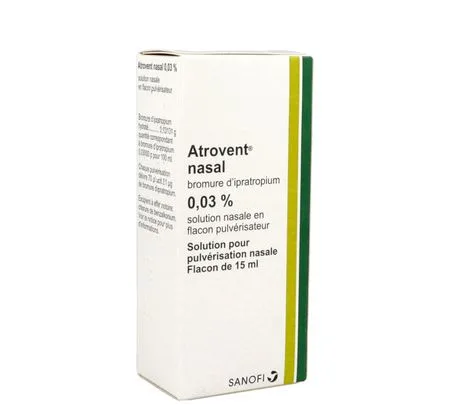
ATROVENT NASAL 0,03 percent, nasal solution in spray bottle
Composition
Ipratropium bromide hydrate.............................................................................................................0,03131 g
Quantity corresponding to ipratropium bromide..............................................................................0,03000 g
For 100 ml.
Each spray delivers 70 µl, i.e. 21 µg of ipratropium bromide.
Excipient(s) with known effect: benzalkonium chloride 25 mg per 100 ml of solution (see section Warnings and precautions).
Sodium chloride, benzalkonium chloride, sodium edetate dihydrate, hydrochloric acid, purified water.
Indications
Symptomatic treatment of serous-mucous rhinorrhoea of non-infected, non-allergic vasomotor rhinitis.
Adjunctive treatment of serous-mucous rhinorrhoea of non-infected allergic rhinitis.
Dosage and administration
Dosage
Reserved for adults:
2 sprays (42 µg) in each nostril, 2 to 3 times a day.
Method of administration
Blow your nose before each administration.
The nasal tip should be cleaned before and after each use.
Contraindications
Hypersensitivity to the active substance, to atropine or its derivatives, or to any of the excipients listed in the section Composition
Infectious rhinitis (risk of sinusitis favoured by drying of the pituitary mucosa).
Warnings and precautions
Special warnings
There is no therapeutic benefit in increasing the number of doses per day.
In the absence of data in children, ATROVENT NASAL 0,03%, nasal solution in spray bottle, must not be used in children under 15 years of age.
This medicine contains 3,75 mg of benzalkonium chloride per 15 ml bottle: this may cause irritation or oedema of the nasal mucosa, particularly with long-term use, and respiratory discomfort.
Due to its anticholinergic activity, accidental splashing of ipratropium into the eye causes mydriasis through a parasympatholytic effect and exposes predisposed subjects to a risk of acute angle-closure glaucoma attack.
The appearance of signs of angle-closure glaucoma (eye pain or discomfort, blurred vision, perception of coloured halos, conjunctival redness, corneal congestion) requires interruption of treatment and immediate specialist medical advice.
Precautions for use
In case of bacterial infection, the risk of sinusitis is favoured by drying of the pituitary mucosa related to administration of the product.
Treatment with ipratropium bromide should be prescribed with caution in elderly people, particularly in male subjects with a history of urinary tract obstruction (for example, prostatic adenoma or urethral obstruction).
Ipratropium bromide should be used with caution in patients with cystic fibrosis, who are more often prone to gastrointestinal motility disorders.
Patients should be trained in the correct use of ATROVENT NASAL 0,03%, nasal solution in a spray bottle.
Interactions
Associations to be taken into account
+ Anticholinergic medicines
It must be taken into account that anticholinergic substances may add up their undesirable effects and more easily lead to urinary retention, an acute glaucoma attack, constipation, dry mouth, etc…
The various anticholinergic medicinal products are the imipramine-type antidepressants, the H1 antihistamines with anticholinergic properties, the anticholinergic antiparkinsonian agents, the anticholinergic antispasmodics, disopyramide, the phenothiazine neuroleptics, as well as clozapine.
Fertility, pregnancy and breastfeeding
Pregnancy
Animal studies have not shown any teratogenic effect. In the absence of a teratogenic effect in animals, a malformative effect in humans is not expected. Indeed, to date, substances responsible for malformations in humans have been shown to be teratogenic in animals in well-conducted studies in two species.
Preclinical studies carried out with ipratropium did not reveal any harmful effect on fertility (see section Preclinical safety). Clinical data on fertility are not available for ipratropium.
In clinical practice, no particular malformative or fetotoxic effect has appeared to date. However, the follow-up of pregnancies exposed to ipratropium bromide is insufficient to exclude any risk.
Consequently, the use of ipratropium bromide should be considered during pregnancy only if necessary. In case of administration at the end of pregnancy, take into account the possible consequences for the newborn of the atropine-like properties of this molecule.
Breast-feeding
In the absence of data on the passage of ipratropium into milk, and given its atropine-like properties, its use is not recommended during breastfeeding unless absolutely necessary.
Driving and using machines
The effects on the ability to drive vehicles and use machines have not been studied. However, patients must be informed of the possible occurrence of undesirable effects such as dizziness, accommodation disorders, mydriasis and blurred vision during treatment with ATROVENT®. Consequently, caution should be exercised when driving a vehicle or using a machine. If the undesirable effects mentioned above occur, patients should avoid potentially dangerous tasks, such as driving or using machines.
Adverse effects
A large number of the undesirable effects listed may be attributed to the anticholinergic properties of ATROVENT NASAL 0,03%, nasal solution in a spray bottle. As with all topical treatments, ATROVENT NASAL 0,03%, nasal solution in a spray bottle may cause symptoms of local irritation. The undesirable effects were identified from data obtained from clinical trials and pharmacovigilance during use of the medicinal product after its marketing authorisation.
The undesirable effects most frequently reported in clinical trials were epistaxis, nasal dryness, headache, nasal discomfort and throat irritation.
The undesirable effects have been classified according to their frequency using the following classification:
Very common (≥ 1/10); common (≥ 1/100, < 1/10); uncommon (≥ 1/1000, < 1/100); rare (≥ 1/10000, < 1/1000); very rare (< 1/10000); frequency not known (cannot be estimated from the available data).
|
MedDRA preferred term |
Frequency |
|
AImmune system disorders Hypersensitivity Anaphylactic reaction |
Uncommon Uncommon |
|
Nervous system disorders Headache Dizziness sensations |
Common Uncommon |
|
Eye disorders Disorders of visual accommodation Mydriasis Ocular pain Increased intraocular pressure Angle-closure glaucoma Blurred vision Halo vision Conjunctival hyperaemia Corneal edema |
Uncommon Uncommon Uncommon Uncommon Uncommon Uncommon Uncommon Uncommon Uncommon |
|
Cardiac disorders Supraventricular tachycardia Atrial fibrillation Tachycardia Palpitations |
Uncommon Uncommon Uncommon Rare |
|
Respiratory, thoracic and mediastinal disorders Epistaxis Nasal dryness Pharyngeal irritation Nasal discomfort Bronchospasm Laryngospasm Pharyngeal edema Dryness of the throat |
Common Common Common Common Uncommon Uncommon Uncommon Uncommon |
|
Gastrointestinal disorders Dry mouth Nausea Gastrointestinal motility disorders (constipation, diarrhea, vomiting) Oral edema Stomatitis |
Uncommon Uncommon Uncommon
Uncommon Uncommon |
|
Skin and subcutaneous tissue disorders Rash Quincke's oedema Pruritus Urticaria |
Uncommon Uncommon Rare Rare |
|
Renal and urinary disorders Urinary retention |
Uncommon |
Reporting of suspected adverse reactions
Reporting suspected adverse reactions after authorisation of the medicinal product is important. It allows continued monitoring of the benefit/risk balance of the medicinal product. Healthcare professionals are asked to report any suspected adverse reaction via the national reporting system: National Agency for the Safety of Medicines and Health Products (ANSM) and the network of Regional Centres of Pharmacovigilance - Website: www.signalement-sante.gouv.fr.
Overdose
Repeated abusive inhalation may promote the occurrence of adverse effects, in particular dry mouth, accommodation disorders, tachycardia.
Management: symptomatic treatment of the disorders.
Pharmacodynamics
Pharmacotherapeutic class: anticholinergic bronchodilator for nasal use, ATC code: R03BB01.
Ipratropium bromide is a quaternary ammonium derived from atropine. It exerts an anticholinergic effect through muscarinic antagonist action. It directly reduces the secretion of mucous and seromucous nasal glands, particularly in cases of hypersecretion.
In a 8-week study conducted in adults with allergic rhinitis, doses up to 168 mcg/nostril 2 times daily were well tolerated and effective, with a faster onset of action.
Pharmacokinetics
Ipratropium is a quaternary amine that is rapidly but poorly absorbed from the nasal mucosa. In healthy volunteers, less than 10 % of a dose administered nasally was excreted unchanged in the urine over 24 hours.
The amount absorbed after inhaled administration is minimal, and the low serum levels would correspond to partial intestinal absorption of the swallowed fraction, which is very poorly absorbed by the digestive route. After oral administration, this absorption can be estimated at between 15 and 30 % of the administered amount.
Binding to plasma proteins is less than 20 %.
The elimination half-life is in the order of 3,5 to 4 hours. Excretion occurs mainly via the urinary route.
After administration by inhalation, passage across the blood-brain barrier is very low.
Systemic absorption of ipratropium through the inflamed nasal mucosa, as estimated from renal excretion of ipratropium over 24 hours, was not modified by experimentally induced cold. After a single dose or administration 4 times daily, 6 to 8 % of ipratropium was excreted unchanged in healthy volunteers as well as in infected volunteers. After chronic administration in patients with rhinitis, the amount of unchanged ipratropium excreted in urine over a period of 24 hours at steady state was 4 to 6 % of the dose. If the value of 50 % of the dose excreted in urine after intravenous administration reported in the literature is applied, the estimated bioavailability of ipratropium after nasal administration is less than 20 %.
The kinetic parameters describing the fate of ipratropium were calculated from plasma concentrations after i.v. administration.
A rapid biphasic decline in plasma concentrations is observed. The apparent volume of distribution at steady state (Vdss) is approximately 176 l (2,4 l/kg). The drug binds minimally (less than 20 %) to plasma proteins. The quaternary amine ipratropium does not cross the blood-brain barrier.
The half-life of the terminal elimination phase is approximately 1,6 hour.
Ipratropium has a total clearance of 2,3 l/min and a renal clearance of 0,9 l/min. After intravenous administration, approximately 60 % of the dose is metabolised, probably mostly in the liver by oxidation.
In a mass balance excretion study, cumulative renal excretion (6 days) of drug-related radioactivity (including the parent compound and all its metabolites) represented 72,1 % after intravenous administration, 9,3 % after oral administration and 3,2 % after inhalation. Total radioactivity excreted via faeces was 6,3 % after intravenous administration, 88,5 % after oral administration and 69,4 % after inhalation. Predominant excretion of drug-related radioactivity therefore occurs via the kidneys. The main urinary metabolites bind weakly to muscarinic receptors and should be considered inactive.
Preclinical safety
The local and systemic tolerance of ipratropium bromide has been studied extensively in several animal species, using various routes of administration. Acute toxicity by inhalation, oral administration and intravenous administration was assessed in several rodent and non-rodent species.
After inhalation, the minimum lethal dose in male guinea pigs is 199 mg/kg. In rats, no mortality was observed up to the highest technically feasible doses (i.e. 0,05 mg/kg after 4 h of administration or 160 puffs of ipratropium bromide, 0,02 mg/puff). The oral LD50 values in mice, rats and rabbits are 1 585, 1 925 and 1 920 mg/kg, respectively. The intravenous LD50 in mice, rats and dogs is, respectively, 13,6, 15,8 and approximately 18,2 mg/kg. Clinical signs include mydriasis, dry oral mucosa, dyspnoea, tremors, spasms and/or tachycardia. Repeated-dose toxicity studies were conducted in rats, rabbits, dogs and rhesus monkeys.
In inhalation studies of up to 6 months' duration in rats, dogs and rhesus monkeys, the NOAEL (no observed adverse effect level) was 0,38 mg/kg/day, 0,18 mg/kg/day and 0,8 mg/kg/day, respectively. Dry oral mucosa and tachycardia were noted in dogs. No substance-related histopathological lesions were observed in the bronchopulmonary system or in any other organ. In rats, the NOAEL after 18 months of oral administration was 0,5 mg/kg/day.
Repeated-dose inhalation toxicity studies of up to 6 months in rats and 3 months in dogs, using other formulations (intranasal, with HFA 134a propellant and with lactose powder), revealed no additional information on the overall toxicity profile of ipratropium bromide. Intranasal administration for up to 6 months revealed a NOEL (no-effect dose) > 0,20 mg/kg/day in dogs and confirmed previous studies of intranasal administration for up to 13 weeks. Repeated-dose toxicity studies of ipratropium bromide showed that the toxicological profiles of the HFA formulation and the conventional CFC preparation are similar.
An aqueous solution of ipratropium bromide (0,05 mg/kg) was well tolerated locally when administered by inhalation to rats (single administration over 4 h). In repeated-dose toxicity studies, ipratropium bromide was well tolerated locally.
No active anaphylaxis or passive cutaneous anaphylactic reaction was demonstrated in guinea pigs. No genotoxicity was observed in vitro (Ames test), nor in vivo (micronucleus test, dominant lethal test in mice, cytogenetic assay on bone marrow cells of Chinese hamsters). No tumorigenic or carcinogenic effect was demonstrated in long-term studies in mice and rats.
Studies to explore the possible influence of ipratropium bromide on fertility, embryonic and foetal toxicity and peri-/postnatal development have been conducted in mice, rats and rabbits.
High oral dose levels, namely 1 000 mg/kg/day in rats and 125 mg/kg/day in rabbits, were associated with maternal toxicity in both species and with embryonic/foetal toxicity in rats, where foetal weight was reduced. No treatment-related malformations were observed.
The highest technically achievable doses for inhalation by metered-dose aerosol, of 1,5 mg/kg/day in rats and 1,8 mg/kg/day in rabbits, were not associated with any adverse effect on reproduction.
Special storage precautions
No special precautions for storage.
The nasal solution is stable for 1 year after opening.
Do not expose to excessive heat.
Do not freeze.
SPECIAL PRECAUTIONS FOR DISPOSAL AND OTHER HANDLING
1. Remove the clear plastic protective cap.
2. Before first use of ATROVENT NASAL, the valve must be primed. To do so, place the thumb on the base of the cartridge and the index and middle fingers on the white shoulder. Make sure the bottle is in an upright position and not directed towards the eyes. Press firmly and quickly with the thumb seven times. The valve is then primed. Re-priming will no longer be necessary, except after non-use for more than 24 hours. Re-priming requires only one or two presses.
3. Before spraying ATROVENT NASAL, blow the nose gently to clear nasal secretions.
4. Block one nostril by gently pressing a finger on the side of the nose. Tilt the head slightly forward and, while keeping the bottle perfectly upright, insert the nasal tip into the other nostril. Direct the tip towards the back and outer wall of the nose.
5. Press firmly and quickly with the thumb on the base of the cartridge, with the index and middle fingers placed on either side of the white shoulder. After each spray, breathe in deeply and then breathe out through the mouth.
6. After spraying, remove the tip from the nostril and tilt the head back for a few seconds so that the product spreads to the back of the nose.
7. Repeat steps 4 to 6 in the other nostril.
8. Replace the clear plastic protective cap.
9. Cleaning the bottle: for hygiene reasons, the nasal tip must be cleaned regularly. Remove the clear protective cap. Rinse the tip under a lukewarm tap for about one minute. Dry the tip, re-prime the valve, then replace the protective cap.
Prescription, supply and reimbursement
| Marketing authorisation (AMM) |
|
| Price: |
|
Collection.
CENTRAL PARK 9-15 RUE MAURICE MALLET
92130 ISSY-LES-MOULINEAUX
Tel: 01 46 94 86 86 contact@eglabo.fr
https://www.eglabo.fr/
Source: VIDAL · Updated on 10/11/2026. This information does not replace advice from a healthcare professional.