
Medicines
SmPC of 19/03/2020
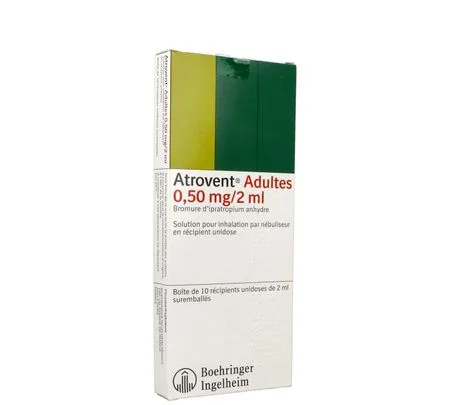
ATROVENT ADULTS 0,50 mg/2 mL, solution for inhalation by nebulizer in single-dose container
Composition
Anhydrous ipratropium bromide ..................................................................................................0,500 mg
As ipratropium bromide ........................................................................................0,522 mg
For a single-dose container of 2 mL.
Sodium chloride, concentrated hydrochloric acid, purified water (or water for injections).
Indications
Symptomatic treatment of severe acute asthma and acute exacerbations of chronic obstructive pulmonary disease in adults in combination with a fast-acting beta2 agonist.
Note: severe acute asthma requires hospitalisation in a specialised setting. Oxygen therapy and systemic corticosteroid therapy must be combined with the bronchodilator treatment.
Dosage and administration
Dosage
The patient must be informed that in case of acute dyspnoea or rapid worsening, a doctor must be consulted immediately.
In adults the usual dose is 0,5 mg per nebulization, i.e. 1 unit dose of 2 mL diluted in physiological saline so as to obtain a volume of 5 mL.
Nebulisations may be repeated every 20 to 30 minutes depending on the patient's clinical condition.
Method of administration
This ipratropium solution must be administered by inhalation using a nebulisation device (nebuliser).
Do not inject - do not swallow.
Follow the instructions for use of the device used.
Dilute the required quantity of ipratropium in physiological saline so as to obtain a total volume of 5 mL.
The resulting mixture is nebulised by a flow of air or oxygen (6 to 8 litres/minute) for approximately 10 to 15 minutes during which the patient breathes at their usual rate.
The technique of use by the patient must be checked regularly.
After inhalation, the unused solution remaining in the nebuliser reservoir must be discarded.
The ATROVENT solution for inhalation is suitable for concomitant inhalation with a fast-acting beta2 agonist.
Contraindications
Hypersensitivity to the active substance, to atropine or its derivatives, or to any of the excipients listed in the section Composition.
Warnings and precautions
Special warnings
The bronchodilator action of inhaled ipratropium is less potent than that of inhaled beta2 agonists. In case of an asthma attack or acute bronchospasm, it should not be used as first-line or alone but a beta2 agonist should also be administered.
Administration of ipratropium by nebuliser should be reserved for severe acute situations requiring inhalation of a high dose of the product by inhalation. These situations require medical monitoring with the possibility of resuscitation (venous access and respiratory support); oxygen therapy and systemic corticosteroid therapy should generally be associated.
The appearance of signs of angle-closure glaucoma (eye pain or discomfort, blurred vision, perception of coloured halos, conjunctival redness, corneal congestion) requires interruption of treatment and immediate specialist medical advice.
As with other inhaled medicines, ATROVENT may cause paradoxical bronchospasm that can be life-threatening. If paradoxical bronchospasm occurs, ATROVENT must be stopped immediately and an alternative treatment must be instituted.
Precautions for use
In case of bronchial infection or abundant bronchorrhea, appropriate treatment is necessary in order to promote optimal distribution of the product in the airways.
Due to the anticholinergic activity of ipratropium, accidental projection of ipratropium into the eye causes mydriasis through a parasympatholytic effect. Patients predisposed to a risk of angle-closure glaucoma should protect themselves from the risks of intraocular projection of this medicine (e.g., wearing glasses). It is preferable to administer the nebulised ipratropium solution via a mouthpiece. An inhalation mask may also be used provided that it is airtight.
Treatment with ipratropium bromide should be prescribed with caution in elderly people, particularly in male subjects with a history of urinary tract obstruction (for example, prostatic adenoma or urethral obstruction).
Ipratropium bromide should be used with caution in patients with cystic fibrosis, who are more often prone to gastrointestinal motility disorders.
Interactions
Associations to be taken into account
+ Anticholinergic medicines
It must be taken into account that atropine-like substances may add up their undesirable effects and more easily cause urinary retention, an acute glaucoma attack, constipation, dry mouth, etc.
The various anticholinergic medicines are represented by imipramine-like antidepressants, most anticholinergic H1 antihistamines, anticholinergic antiparkinsonian agents, anticholinergic antispasmodics, disopyramide, phenothiazine neuroleptics as well as clozapine.
+ Anticholinesterase medicines
Risk of reduced efficacy of the anticholinesterase through antagonism of acetylcholine receptors by atropine
+ Morphinics
Significant risk of colonic akinesia, with severe constipation
Fertility, pregnancy and breastfeeding
Pregnancy
Animal studies have not shown any teratogenic effect. In the absence of a teratogenic effect in animals, a malformative effect in humans is not expected. Indeed, to date, substances responsible for malformations in humans have been shown to be teratogenic in animals in well-conducted studies in two species.
In clinical practice, no particular malformative or foetotoxic effect has appeared to date. However, the follow-up of pregnancies exposed to ipratropium bromide is insufficient to exclude any risk.
Consequently, the use of ipratropium bromide should be considered during pregnancy only if necessary. In case of administration at the end of pregnancy, take into account the possible consequences for the newborn of the atropine-like properties of this molecule.
Breast-feeding
In the absence of data on the passage of ipratropium into milk, and given its atropine-like properties, its use is not recommended during breastfeeding unless absolutely necessary.
Fertility
Preclinical studies carried out with ipratropium bromide have not revealed any harmful effects on fertility (see section Preclinical safety). Clinical data on fertility are not available for ipratropium bromide.
Driving and using machines
The effects on the ability to drive vehicles and use machines have not been studied.
Patients must be informed of the risk of visual accommodation disorders, mydriasis, blurred vision and possible dizziness during treatment with ATROVENT. Therefore, caution should be exercised when driving a vehicle or using a machine.
Adverse effects
Most of the listed undesirable effects can be attributed to the anticholinergic properties of ATROVENT.
As with all inhalation treatments, ATROVENT may cause local irritation symptoms.
Summary of the safety profile
The undesirable effects most frequently reported in clinical trials were headache, throat irritation, cough, dry mouth, gastrointestinal motility disorders (constipation, diarrhoea and vomiting), nausea and dizziness.
Summary table of undesirable effects
The following undesirable effects have been reported in clinical trials conducted with ATROVENT and from post-marketing experience.
Undesirable effects have been classified according to their frequency using the following classification:
Very common (≥ 1/10); common (≥ 1/100, < 1/10); uncommon (≥ 1/1 000, < 1/100); rare (≥ 1/10 000, < 1/1 000); very rare (< 1/10 000); frequency not known (cannot be estimated from the available data).
|
MedDRA preferred term |
Frequency |
|
Immune system disorders |
|
|
Hypersensitivity |
Uncommon |
|
Anaphylactic reaction |
Uncommon |
|
Nervous system disorders |
|
|
Headache |
Common |
|
Dizziness sensations |
Common |
|
Eye disorders |
|
|
Angle-closure glaucoma |
Uncommon |
|
Increased intraocular pressure |
Uncommon |
|
Mydriasis |
Uncommon |
|
Ocular pain |
Uncommon |
|
Corneal edema |
Uncommon |
|
Conjunctival hyperaemia |
Uncommon |
|
Halo vision |
Uncommon |
|
Blurred vision |
Uncommon |
|
Disorders of visual accommodation |
Rare |
|
Cardiac disorders |
|
|
Supraventricular tachycardia |
Uncommon |
|
Palpitations |
Uncommon |
|
Atrial fibrillation |
Rare |
|
Tachycardia |
Rare |
|
Respiratory, thoracic and mediastinal disorders |
|
|
Cough |
Common |
|
Pharyngeal irritation |
Common |
|
Paradoxical bronchospasm |
Uncommon |
|
Bronchospasm |
Uncommon |
|
Laryngospasm |
Uncommon |
|
Pharyngeal edema |
Uncommon |
|
Dryness of the throat |
Uncommon |
|
Gastrointestinal disorders |
|
|
Dry mouth |
Common |
|
Nausea |
Common |
|
Gastrointestinal motility disorders |
Common |
|
Constipation |
Uncommon |
|
Vomiting |
Uncommon |
|
Diarrhoea |
Uncommon |
|
Buccal oedema |
Uncommon |
|
Stomatitis |
Uncommon |
|
Skin and subcutaneous tissue disorders |
|
|
Skin rashes |
Uncommon |
|
Pruritus |
Uncommon |
|
Quincke's oedema |
Uncommon |
|
Urticaria |
Rare |
|
Renal and urinary disorders |
|
|
Urinary retention |
Uncommon |
Reporting of suspected adverse reactions
Reporting suspected adverse reactions after authorisation of the medicinal product is important. It allows continued monitoring of the benefit/risk balance of the medicinal product. Healthcare professionals are asked to report any suspected adverse reactions via the national reporting system: National Agency for the Safety of Medicines and Health Products (ANSM) and the network of Regional Pharmacovigilance Centres - Website: www.signalement-sante.gouv.fr.
Overdose
Excessive repeated inhalation may promote the occurrence of local adverse effects (dry mouth, pharyngeal irritation) and the onset of systemic anticholinergic effects.
Pharmacodynamics
Pharmacotherapeutic class: anticholinergics, ATC code: R03BB01
Ipratropium is an anticholinergic bronchodilator administered by inhalation.
Administered by inhalation, ipratropium bromide exerts a preferential competitive action at the cholinergic receptors of bronchial smooth muscle, resulting in relaxation of the muscle through a parasympatholytic effect and bronchodilation. Its bronchodilator effect is less potent than that exerted by inhaled beta2 mimetics.
The bronchospasmolytic action appears rapidly (3 minutes) and persists for 4 to 6 hours.
The effects following inhalation of ATROVENT (ipratropium bromide) are mainly local and specific to the lungs, and have no systemic character.
Pharmacokinetics
Absorption
The amount absorbed after administration by inhalation is minimal, and the low serum levels would correspond to partial intestinal absorption of the swallowed fraction, which is very poorly absorbed by the digestive route. After oral administration, this absorption may be estimated at between 15 and 30 % of the administered quantity. The elimination half-life is of the order of 3,5 hours. Excretion occurs essentially via the urinary route.
After administration by inhalation, passage across the blood-brain barrier is very low.
The cumulative renal excretion (0 to 24 hours) of the parent compound is approximately 46 % of an intravenously administered dose, less than 1 % of an oral dose and approximately 3 to 13 % of an inhaled dose. On the basis of these data, the total systemic bioavailability of oral and inhaled doses of ipratropium bromide is estimated at 2 % and 7 to 28 %, respectively.
Consequently, the portions of the ipratropium bromide dose that are swallowed do not contribute significantly to systemic exposure.
Distribution
The kinetic parameters describing the fate of ipratropium were calculated from plasma concentrations after intravenous administration. A rapid biphasic decline in plasma concentrations is observed. The apparent volume of distribution at steady state (Vdss) is approximately 176 L (approximately 2,4 L/kg). The drug binds minimally (less than 20 %) to plasma proteins. Preclinical data indicate that the quaternary amine ipratropium does not cross the placenta or the blood-brain barrier.
Biotransformation
After intravenous administration, approximately 60 % of the dose is metabolised, probably most of it in the liver by oxidation.
The known metabolites, which are formed by hydrolysis, dehydration or elimination of the hydroxymethyl group in the tropic acid moiety, show very little or no affinity for muscarinic receptors and should be considered inactive.
Elimination
The half-life of the terminal elimination phase is approximately 1,6 hour.
Ipratropium has a total clearance of 2,3 L/min and a renal clearance of 0,9 L/min.
In an excretion balance study, the cumulative renal excretion (6 days) of drug-related radioactivity (including the parent compound and all its metabolites) accounted for 72,1 % after intravenous administration, 9,3 % after oral administration and 3,2 % after inhalation. The total radioactivity excreted via the faeces was 6,3 % after intravenous administration, 88,5 % after oral administration and 69,4 % after inhalation. With regard to the excretion of drug-related radioactivity after intravenous administration, the main excretion occurs via the kidneys. The elimination half-life of drug-related radioactivity (parent compound and metabolites) is 3,6 hours.
Preclinical safety
The local and systemic tolerance of ipratropium bromide has been extensively studied in several animal species, using various routes of administration.
Single-dose toxicity
Acute toxicity by inhalation, oral administration and intravenous administration has been evaluated in several species of rodents and non-rodents.
Following inhalation, the minimum lethal dose in male guinea pigs is 199 mg/kg.
In rats, no mortality was observed up to the highest technically feasible doses (i.e. 0,05 mg/kg after 4 h of administration or 160 puffs of ipratropium bromide, 0,02 mg/puff).
The oral LD50 values in mice, rats and rabbits are 1 585, 1 925 and 1 920 mg/kg, respectively. The intravenous LD50 in mice, rats and dogs is 13,6, 15,8 and approximately 18,2 mg/kg, respectively. Clinical signs include mydriasis, dryness of the oral mucosa, dyspnoea, tremors, spasms and/or tachycardia.
Repeated-dose toxicity
Repeated-dose toxicity studies have been conducted in rats, rabbits, dogs and rhesus monkeys.
In inhalation studies lasting up to 6 months in rats, dogs and rhesus monkeys, the NOAEL (no observed adverse effect dose) was 0,38 mg/kg/day, 0,18 mg/kg/day and 0,8 mg/kg/day, respectively. Dryness of the oral mucosa and tachycardia were noted in dogs. No histopathological lesions related to the substance were observed in the bronchopulmonary system or in any other organ. In rats, the NOAEL after 18 months of oral administration was 0,5 mg/kg/day.
Local tolerance
An aqueous solution of ipratropium bromide (0,05 mg/kg) was well tolerated locally when administered to rats by inhalation (single administration over 4 h). In repeated-dose toxicity studies, ipratropium bromide was well tolerated locally.
Immunogenicity
No active anaphylaxis or passive cutaneous anaphylactic reaction has been demonstrated in guinea pigs.
Genotoxicity and carcinogenicity
No genotoxicity was observed in vitro (Ames test) or in vivo (micronucleus test, dominant lethal test in mice, cytogenetic assay on bone marrow cells of Chinese hamsters).
No tumorigenic or carcinogenic effect has been demonstrated in long-term studies in mice and rats.
Reproductive and developmental toxicity
Studies to explore the possible influence of ipratropium bromide on fertility, embryonic and foetal toxicity and peri-/postnatal development have been conducted in mice, rats and rabbits.
High oral dose levels, i.e. 1 000 mg/kg/day in rats and 125 mg/kg/day in rabbits, were associated with maternal toxicity in both species and with embryonic/foetal toxicity in rats, where foetal weight was reduced. No treatment-related malformations were observed.
The highest technically feasible doses for inhalation via the metered-dose aerosol, of 1,5 mg/kg/day in rats and 1,8 mg/kg/day in rabbits, were not associated with any adverse effect on reproduction.
INCOMPATIBILITIES
Benzalkonium chloride
This medicinal product must not be mixed with a solution containing benzalkonium chloride due to the risk of physicochemical incompatibility.
Disodium cromoglycate
The ATROVENT inhalation solution in single-dose vials and the disodium cromoglycate inhalation solutions must not be administered simultaneously in the same nebuliser.
Special storage precautions
To be stored in the original packaging, protected from light.
Store at a temperature not exceeding 25 °C.
Prescription, supply and reimbursement
Prescription restricted to specialists in paediatrics and pneumology.
Medicine reserved for use in emergency situations.
| Marketing authorisation (AMM) |
|
| Price: |
|
Collection.
100-104 AVENUE DE FRANCE
75013 PARIS
Tel: 04 72 72 30 00 https://www.boehringer-ingelheim.fr/
Source: VIDAL · Updated on 10/11/2026. This information does not replace advice from a healthcare professional.