Medicines
Updated on 19/10/2026
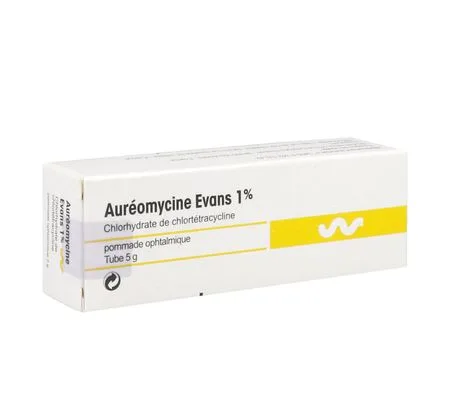
AUREOMYCINE EVANS® 1 %
chlortetracycline
Forms and presentations
Ophthalmic ointment: Tube of 5 g, fitted with a tamper-evident ring.Composition
| per tube | |
| Chlortetracycline hydrochloride
|
50 mg |
Excipient with known effect: wool fat (lanolin).
Indications
- Local antibacterial treatment of conjunctivitis, keratitis, corneal ulcers, blepharitis and stye due to germs sensitive to chlortetracycline.
- Treatment of trachoma.
Dosage and administration
Dosage1 to 2 applications per day, preferably one application in the evening, for 7 days on average.
- Special case: trachoma:
- 1 application 2 times per day for 6 weeks.
Method of administration:
Topical route. Ocular application.
Apply an amount equivalent to a half-centimetre ribbon of ointment into the lower conjunctival sac of the affected eye(s) and possibly along the edge of the eyelid. To do so, pull the eyelid downward while looking upward and deposit the ointment between the eyelid and the eyeball.
Do not touch the eye or eyelids with the tip of the tube.
Replace the cap on the ointment tube after use.
Contraindications
Hypersensitivity to the active substance or to any of the excipients listed in section Composition.Warnings and precautions
Warnings:
In case of hypersensitivity, stop treatment.
This medicine contains lanolin (wool fat) and may cause local skin reactions (for example contact dermatitis).
Precautions for useIn the absence of rapid improvement or in case of prolonged treatment, regular medical monitoring including bacteriological tests with study of the germ's sensitivity allows detection of resistance to the product and possible adjustment of treatment.
The use of this medicine should be avoided in children under 8 years (risk of tooth discolouration), as well as in pregnant or breastfeeding women (risk of tooth bud abnormality or tooth discolouration in the child).
Interactions
The data available to date do not suggest the existence of clinically significant interactions.
Fertility, pregnancy and breastfeeding
Pregnancy:In case of ocular administration, systemic absorption is not negligible. However, compared with the eye drop form, systemic absorption of the ointment form is probably very low. A teratogenic effect of cyclines has been found in animal experiments but inconsistently.
Administration of cyclines during the second and third trimesters of pregnancy exposes the fetus to the risk of staining of the milk teeth. Consequently, the use of Auréomycine Evans 1 %, ophthalmic ointment, is acceptable during the first trimester of pregnancy, and should be avoided as a precaution from the second trimester onward.
Breastfeeding:
During breastfeeding, the use of Auréomycine Evans 1 %, ophthalmic ointment, should be avoided as a precaution beyond 10 days of treatment.
Driving and using machines
A transient visual disturbance related to the pharmaceutical form of Auréomycine Evans 1 %, ophthalmic ointment, may be experienced after administration of the product. In this case, the patient is advised not to drive or use machines until normal vision returns.Adverse effects
- Possibility of transient irritation, such as a burning sensation of the conjunctiva.
- Risk of hypersensitivity reaction and contact eczema with prolonged use.
Reporting suspected adverse reactions after authorisation of the medicinal product is important. It allows continuous monitoring of the benefit/risk balance of the medicinal product. Healthcare professionals should report any suspected adverse reaction via the national reporting system: National Agency for the Safety of Medicines and Health Products (ANSM) and the network of Regional Pharmacovigilance Centres. Website: https://signalement.social-sante.gouv.fr.
Overdose
No cases of overdose have been reported. However, prolonged repeated instillations may lead to non-negligible systemic absorption of the active ingredients, in addition to an exacerbation of local adverse effects.
Pharmacodynamics
Pharmacotherapeutic class: Ophthalmic antibiotic - ATC code: S01AA02.
Chlortetracycline is a bacteriostatic antibiotic of the tetracycline family.
Its antibacterial activity is exerted by inhibition of protein synthesis.
- Spectrum of antibacterial activity:
- Critical concentrations separate susceptible strains from strains of intermediate susceptibility, and the latter from resistant strains: S ≤ 4 mg/L and R > 8 mg/L.
- The prevalence of acquired resistance can vary according to geography and time for certain species. It is therefore useful to have information on local resistance prevalence, especially for the treatment of severe infections. These data can only provide guidance on the probabilities of the susceptibility of a bacterial strain to this antibiotic.
- When the variability of resistance prevalence in France is known for a bacterial species, the frequency of acquired resistance in France (> 10 %; extreme values) is indicated in parentheses.
-
Susceptible species:
- Aerobic Gram-positive: Bacillus, Enterococci (40 - 80 %), Staphylococcus spp. methicillin-S, Staphylococcus spp. methicillin-R* (70 - 80 %), Streptococcus A (20 %), Streptococcus B (80 - 90 %), Streptococcus pneumoniae (20 - 40 %).
- Aerobic Gram-negative: Branhamella catarrhalis, Brucella, Escherichia coli (20 - 40 %), Haemophilus influenzae (10 %), Klebsiella (10 - 30 %), Neisseria gonorrhoeae, Pasteurella, Vibrio cholerae.
- Anaerobes: Propionibacterium acnes.
- Others: Borrelia burgdorferi, Chlamydia, Coxiella burnetii, Leptospira, Mycoplasma pneumoniae, Rickettsia, Treponema pallidum, Ureaplasma urealyticum.
- Aerobic Gram-positive: Bacillus, Enterococci (40 - 80 %), Staphylococcus spp. methicillin-S, Staphylococcus spp. methicillin-R* (70 - 80 %), Streptococcus A (20 %), Streptococcus B (80 - 90 %), Streptococcus pneumoniae (20 - 40 %).
-
Resistant species:
- Aerobic Gram-negative: Acinetobacter, Proteus mirabilis, Proteus vulgaris, Pseudomonas, Serratia.
- Aerobic Gram-negative: Acinetobacter, Proteus mirabilis, Proteus vulgaris, Pseudomonas, Serratia.
-
* The frequency of methicillin resistance is approximately 30 to 50 % of all staphylococci and is found mainly in hospital settings.
- Note: This spectrum corresponds to that of the systemic forms of this antibiotic. With the local pharmaceutical presentations, the concentrations obtained in situ are much higher than plasma concentrations. Some uncertainties remain regarding the kinetics of the in situ concentrations, the local physicochemical conditions that may modify the activity of the antibiotic, and the stability of the product in situ.
Pharmacokinetics
Chlortetracycline shows poor transcorneal penetration into the healthy eye. This penetration increases significantly in the event of damage to the corneal epithelium.
Storage conditions
- Shelf life
- 3 years.
No special precautions for storage.
- After opening:
- 15 days.
HANDLING/DISPOSAL INSTRUCTIONS
No special requirements.
Prescription, supply and reimbursement
LIST I| Marketing authorisation (AMM) | 3400934213342 (1992, RCP rev 19.12.2023). |
| Not reimbursed by Social Security. Collect. |
Marketing authorisation holder: SCA Pharma.
DB PHARMA Laboratories
1 bis, avenue du Cdt-Rivière
La Varenne-St-Hilaire
94210 Saint-Maur-des-Fossés
Tel: 01 48 83 25 14. Fax: 01 48 83 27 57
http://www.db-pharma.com
Source: VIDAL · Updated on 10/11/2026. This information does not replace advice from a healthcare professional.