Medicines
SmPC of 25/02/2026
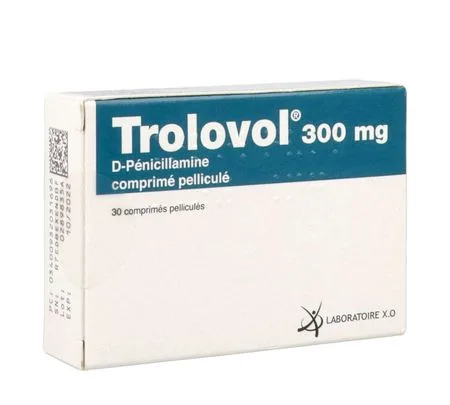
TROLOVOL 300 mg, film-coated tablet
Composition
Penicillamine................................................................................................................................................300 mg
For a film-coated tablet.
Microcrystalline cellulose, mannitol, crospovidone (Kollidon CL), maize starch, gelatin, talc, magnesium stearate, anhydrous colloidal silica (Aerosil 200 V), edetate sodium.
Film coating : titanium dioxide (E 171), talc, macrogol 6000, neutral copolymer of acrylates and methacrylates (Eudragit NE 30 D), polysorbate 80 (Tween 80), sodium carmellose 30 CP, simethicone.
Indications
• Basic treatment of rheumatoid arthritis;
• Treatment of Wilson's disease;
• Treatment of cystinuria;
• Treatment of lead poisoning.
Dosage and administration
Dosage
Paediatric population
The pharmaceutical form of this specialty, tablet dosed at 300 mg may not be suitable for children under 6 years and low-weight children because of its high dosage and the risk of choking.
Rheumatoid arthritis
The dosage must be gradual to reach, without exceeding, the minimum effective dose:
Adults:
300 mg per day, the first month.
600 mg per day, the second month.
If therapeutic effects appear at this dose, it is not necessary to increase it, otherwise switch to 900 mg per day. Exceeding 900 mg per day should be avoided as far as possible.
Always seek the minimum effective dose.
The tablets must be taken away from meals
Children: The usual dose is 15 to 20 mg/kg/day. The initial dose must be lower (between 2.5 and 5 mg/kg/day) then increased every 4 weeks for a period of 3 to 6 months.
Wilson's disease
Adults: 1200 to 1800 mg per day in several divided doses, 30 minutes before meals. This dose must be reached gradually in order to limit hypersensitivity reactions.
After stabilisation of the disease, reduce the dosage to a daily dose of 600 mg to 900 mg. Thereafter, the lowest effective dose necessary to obtain a negative copper balance should be kept to. It is advised not to maintain a dose of 1800 mg per day for more than one year.
Children: 20 mg/kg/day in 2 or 3 divided doses 1 hour before meals. For children over 12 years, the maintenance dose is 0.75 to 1g/day.
Cystinuria
Adults: 3 to 6 tablets per day
Children: 20 to 30 mg/kg/day divided into 2 or 3 doses administered 1 hour before meals. The dosage must be adjusted so as to maintain a urinary cystine level below 200 mg/L.
Lead poisoning
Adults: 3 to 5 tablets per day
Children: Penicillamine should only be used in case of a blood lead level above 45 µg/dL, with a total dose of 15 to 20 mg/kg/day divided into 2 to 3 doses.
Contraindications
• Haematuric and proteinuric nephropathies
• Significant haematological alterations
• Lupus erythematosus, myasthenia gravis, severe dermatoses
• Allergy to penicillins and cephalosporins, due to the possibility, in some individuals, of cross-allergy between beta-lactams and D-penicillamine
• History of serious adverse events (bone marrow aplasia, pemphigus, myasthenia gravis) with thiol derivatives (tiopronin, pyritinol)
Warnings and precautions
Special warnings
Caution when administered with a medicinal product that may cause bone marrow aplasia.
Close clinical and biological monitoring in case of a history of intolerance to tiopronin or pyritinol.
Precautions for use
Close clinical monitoring and regular biological monitoring: full blood count including platelets and proteinuria (weekly monitoring during the first months, then twice monthly); possibly testing for blood in the urine and measurement of serum creatinine.
During treatment of Wilson's disease, it is also necessary to monitor the disappearance of the Kayser-Fleischer green ring and the increase in urinary copper, which should ensure a negative urinary copper balance. A worsening of neurological signs in the first months of treatment of neurological forms should prompt discussion of the usefulness of continuing this treatment.
The occurrence of unexplained dyspnoea must lead to discontinuation of the medicinal product and prompt radiographic and respiratory functional assessment.
When treatment with gold salts has had to be stopped due to adverse effects, it is, as a precaution, advised to start treatment with D-penicillamine only 6 months after these have resolved.
Interactions
Associations requiring precautions for use
+ Iron (salts)
Decreased digestive absorption of penicillamine. Take iron salts at a distance from penicillamine (more than 2 hours, if possible).
+ Gastrointestinal topicals
Decreased digestive absorption of penicillamine. Take gastrointestinal topicals at a distance from penicillamine (more than 2 hours, if possible).
Fertility, pregnancy and breastfeeding
Pregnancy
Studies carried out in animals have demonstrated a teratogenic effect of D-penicillamine related to the formation of connective tissue.
Epidemiological studies conducted on small numbers appear to suggest a real but very weak malformative effect of D-penicillamine compared with an untreated population. When D-penicillamine has been given in Wilson's disease, no malformation has been found. The pathophysiological hypothesis put forward is chelation followed by detoxification of D-penicillamine by divalent copper.
Consequently, the use of D-penicillamine during pregnancy will only be considered if the indication is imperative. In the case of Wilson's disease, treatment must not be stopped during pregnancy. Outside these cases, effective contraception is recommended.
Breast-feeding
As the excretion of this product in milk is not known, it is recommended to discontinue breastfeeding during treatment with this medicinal product.
Adverse effects
Adverse effects are presented below in decreasing order of frequency using the following categories: very common (≥ 1/10), common (≥ 1/100 and < 1/10), uncommon (≥ 1/1 000 and < 1/100), rare (≥ 1/10 000 and < 1/1 000), very rare (<1/10 000), frequency not determinable (cannot be estimated from available data).
|
Blood and lymphatic system disorders |
|
|
Frequency not known |
Thrombocytopenia, agranulocytosis, bone marrow aplasia |
|
Immune system disorders |
|
|
Frequency not known |
Allergic reaction including hypersensitivity |
|
Nervous system disorders |
|
|
Frequency not known |
Ageusia |
|
Respiratory, thoracic and mediastinal disorders |
|
|
Frequency not known |
Yellow nail syndrome Interstitial pneumonitis, obliterative bronchiolitis |
|
Gastrointestinal disorders |
|
|
Frequency not known |
Nausea, vomiting, diarrhea Gingivitis, stomatitis, aphthoid lesion |
|
Disorders of the skin and subcutaneous tissues |
|
|
Frequency not known |
Elastosis perforans serpiginosa, pseudoxanthoma elasticum, cutis laxa Rash, pruritus, toxic skin eruption, pemphigus |
|
Musculoskeletal and systemic disorders |
|
|
Frequency not known |
Myasthenia, polymyositis, induced lupus |
|
Renal and urinary disorders |
|
|
Frequency not known |
Proteinuria |
|
Disorders of the reproductive system and breast |
|
|
Frequency not known |
Gynecomastia, breast enlargement |
|
Investigations |
|
|
Frequency not known |
Appearance of antinuclear factors |
Proteinuria (treatment discontinuation especially from 1 g per 24 hours): Cases of severe renal damage or late presentation have been reported: nephrotic syndromes, acute renal failure, glomerulonephritis sometimes severe and possibly progressing to chronic renal failure.
Cases of interstitial pneumonitis and obliterative bronchiolitis have rarely been reported. They are similar to the pulmonary complications of rheumatoid arthritis and may regress upon discontinuation of the medicine.
The appearance of antinuclear factors does not require discontinuation of treatment.
Adverse effects generally justifying discontinuation of treatment:
• Mucocutaneous:
- Early: rash, pruritus;
- Late: gingivitis, stomatitis, aphthoid lesion, toxic skin eruption, pemphigus.
• Renal: proteinuria
• Respiratory: cases of interstitial pneumonia and obliterative bronchiolitis
• Haematological: thrombocytopenia. Cases of agranulocytosis and bone marrow aplasia have been reported.
• Autoimmune: myasthenia, polymyositis, drug-induced lupus.
Reporting of suspected adverse reactions
Reporting suspected adverse reactions after authorisation of the medicinal product is important. It allows continued monitoring of the benefit/risk balance of the medicinal product. Healthcare professionals are asked to report any suspected adverse reaction via the national reporting system: National Agency for the Safety of Medicines and Health Products (ANSM) and the network of Regional Centres of Pharmacovigilance - Website: https://signalement.social-sante.gouv.fr/.
Pharmacodynamics
Pharmacotherapeutic class : SPECIFIC ANTIRHEUMATIC AGENTS, ATC code : M01CC01.
(M: Musculoskeletal system)
Mechanism of action
D-penicillamine is a slow-acting antirheumatic agent. It has the property of chelating heavy metals, in particular serum copper, which explains its use in Wilson's disease. It is a thiol-reducing agent that breaks the disulfide bridges of macroglobulins and produces depolymerisation of IgM rheumatoid factors. It interferes with collagen synthesis.
Pharmacokinetics
After oral administration, 50 to 70 % of D-penicillamine is absorbed. Absorption is reduced by food. The maximum plasma concentration is reached after approximately 2 hours. It then decreases, initially with a half-life of approximately 1 hour, then a half-life of approximately 5 hours. D-penicillamine diffuses into practically all body tissues.
Binding to collagen and elastic fibres is particularly significant.
After oral administration of D-penicillamine, more than 80 % is eliminated in the faeces and urine within 48 hours; the collagen-bound fraction is eliminated slowly with a half-life of several days.
Prescription, supply and reimbursement
| Marketing authorisation (AMM) |
|
| Price: |
|
Collection.
170 HILL OFFICES
92213 SAINT CLOUD CEDEX
Tel: 01 85 74 20 13 info@laboratoirexo.fr
http://www.laboratoirexo.com/
Source: VIDAL · Updated on 11/11/2026. This information does not replace advice from a healthcare professional.