
Medicines
SmPC of 28/07/2023
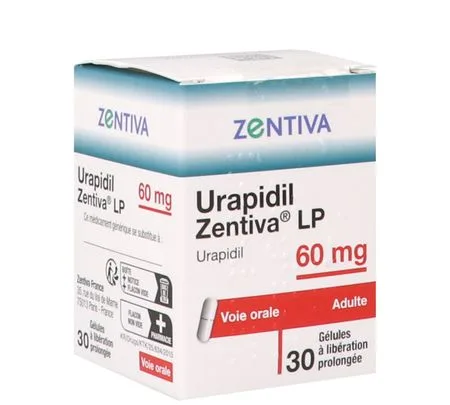
URAPIDIL ZENTIVA LP 60 mg, prolonged-release capsule
Forms and presentations
Prolonged-release capsule.
Spherical granules, white to off-white in colour, contained in a capsule of size "2" with an opaque white cap and a transparent blue body.
Composition
Urapidil...................................................................................................................................................................60 mg
For a prolonged-release capsule
Excipient with a notable effect : sucrose (110 mg), carmoisine (E 122, 0,004 mg)
For the full list of excipients, see section Composition.
Capsule contents :
Sugar spheres, hypromellose, fumaric acid, talc, hypromellose phthalate (HP 55), methacrylic acid and methyl methacrylate copolymer (1/2), stearic acid, diethyl phthalate, ethylcellulose.
Capsule shell :
Gelatin, titanium dioxide (E 171), brilliant blue (E 133), carmoisine (E 122).
Dosage and administration
Dosage
The recommended initial dose is 30 mg of urapidil twice daily.
To achieve a faster reduction in blood pressure, treatment may be started with 60 mg of urapidil twice daily.
The dose may be adjusted stepwise to the individual needs of the patient. The dosage interval for maintenance treatment is between 60 and 180 mg of urapidil per day, the total quantity being divided into two separate intakes.
Treatment of arterial hypertension with this medicine requires regular medical monitoring.
Insuffisance hepatic
In patients with hepatic impairment, it may be necessary to reduce the dose.
Insuffisance renale
In patients with moderate to severe renal impairment, it may be necessary to reduce the dosage.
Elderly patients
In elderly patients, antihypertensive agents should be administered with caution and starting at low doses.
Paediatric population
The safety and efficacy of urapidil in children aged 0 to 18 years have not been established.
No recommendation on dosage can be given.
Method of administration
Oral use.
It is recommended to take the capsules during meals, in the morning and in the evening.
The capsules must be swallowed whole with a drink and must not be opened, crushed, chewed or dissolved.
Contraindications
Hypersensitivity to the active substance or to any of the excipients listed in section Composition.
Warnings and precautions
Precautions for use
• In cardiac insufficiency of mechanical origin, such as aortic or mitral stenosis, pulmonary embolism, or disturbance of cardiac function related to a pericardial disease.
• In patients with hepatic impairment.
• In patients with moderate to severe renal impairment.
• In elderly patients.
• In patients receiving concomitant treatment with cimetidine (see section Interactions).
• Intraoperative floppy iris syndrome (IFIS) has been observed during cataract surgery in some patients receiving or having previously received tamsulosin or other alpha1-blockers. A class effect cannot be excluded.
• IFIS may increase the risk of ocular complications during and after surgery. The patient's ophthalmologist must be informed of alpha1-blocker treatments the patient is currently or was previously receiving.
URAPIDIL ZENTIVA LP contains sucrose. Patients with fructose intolerance, glucose-galactose malabsorption syndrome or sucrase/isomaltase deficiency (rare hereditary diseases) must not take this medicine.
URAPIDIL ZENTIVA LP contains an azo dye (carmoisine [E 122]) which may cause allergic reactions.
Population paediatric
No data are available.
Interactions
The antihypertensive action of urapidil may be increased by concomitant administration of alpha-blockers, including alpha-blockers used for urological purposes, vasodilators and other antihypotensive medicines, as well as in patients with hypovolaemia (diarrhoea, vomiting) and in case of alcohol intake.
The combination of urapidil with baclofen requires precautions for use, as baclofen may increase the antihypertensive effect of urapidil.
Concomitant administration of cimetidine inhibits the metabolism of urapidil. The serum concentration of urapidil could increase by 15 %, so a dose reduction should be considered.
Associations to be taken into account:
• imipramine (antihypertensive effect and risk of orthostatic hypotension);
• neuroleptics (antihypertensive effect and risk of orthostatic hypotension);
• amifostine (antihypertensive effect and risk of orthostatic hypotension); and
• corticosteroids (decreased antihypertensive effect due to corticosteroid-induced sodium and water retention).
In the absence of adequate experience with ACE inhibitors, this combination is currently not recommended.
Fertility, pregnancy and breastfeeding
Pregnancy
It is not recommended to use URAPIDIL ZENTIVA LP in women of childbearing potential who are not using contraception.
There are no data or very limited data on the use of urapidil in pregnant women. Studies carried out in animals have shown reproductive toxicity (see section Preclinical safety).
Urapidil crosses the placental barrier.
URAPIDIL ZENTIVA LP must not be used during pregnancy unless the clinical condition of the patient requires treatment with urapidil.
Breast-feeding
It is not known whether urapidil is excreted in human milk. A risk to newborns/infants cannot be excluded. URAPIDIL ZENTIVA LP is contraindicated during breast-feeding.
Fertility
No clinical study has been conducted to assess the effect of urapidil on male and female fertility.
Animal studies have shown that urapidil has an effect on fertility (see section Preclinical safety).
Driving and using machines
This medicine has a minor influence on the ability to drive and use machines.
The response to treatment may vary from patient to patient. This is particularly the case at the start of treatment, when the treatment is changed, and when alcohol is taken concomitantly.
Adverse effects
The following frequency conventions are used in the evaluation of undesirable effects:
Very common (≥ 1/10), common (≥ 1/100, < 1/10), uncommon (≥ 1/1 000, < 1/100), rare (≥ 1/10 000, < 1/1 000), very rare (< 1/10 000), not known (cannot be estimated from the available data).
|
Frequency
Class of System Organ Classes |
Common |
Uncommon |
Rare |
Very rare |
Frequency not known |
|
Cardiac disorders |
|
Palpitations, tachycardia, bradycardia, feeling of pressure or chest pain (similar to angina pectoris) |
|
|
|
|
Gastrointestinal disorders |
Nausea |
Vomiting, diarrhoea, dry mouth |
|
|
|
|
General disorders and administration site conditions |
|
Fatigue |
|
Oedema |
|
|
Investigations |
|
|
|
Reversible increase in liver enzymes, thrombocytopenias** |
|
|
Nervous system disorders |
Dizziness, headache |
|
|
|
|
|
Psychiatric disorders |
|
Sleep disturbances |
|
Agitation |
|
|
Renal and urinary disorders |
|
|
|
Urgent micturition or worsening of urinary incontinence |
|
|
Disorders of the reproductive system and breast |
|
|
|
Priapism |
|
|
Respiratory, thoracic and mediastinal disorders |
|
Nasal congestion |
|
|
|
|
Skin and subcutaneous tissue disorders |
|
Symptoms of cutaneous allergic reactions (pruritus, skin rash, exanthema) |
|
|
Quincke's oedema, urticaria |
|
Vascular disorders |
|
Orthostatic dysregulation |
|
|
|
* In very rare cases, a reduction in the number of platelets has been observed during administration of urapidil. No causal relationship with urapidil treatment has been established - for example, by immuno-haematological tests.
Reporting of suspected adverse reactions
Reporting suspected adverse reactions after authorisation of the medicinal product is important. It allows continued monitoring of the benefit/risk balance of the medicinal product. Healthcare professionals are asked to report any suspected adverse reactions via the national reporting system: National Agency for the Safety of Medicines and Health Products (ANSM) and the network of Regional Pharmacovigilance Centres - Website: https://signalement.social-sante.gouv.fr.
Overdose
Symptoms
The symptoms of overdose are dizziness, orthostatic hypotension and collapse, as well as fatigue and a reduction in reaction speed.
Management
An excessive drop in blood pressure can be corrected by elevating the patient's legs and performing volume replacement. If these measures are not sufficient, vasoconstrictors may be administered by slow intravenous injection under blood pressure monitoring. In very rare cases, administration of catecholamines (for example, adrenaline, 0,5–1,0 mg diluted to 10 mL with isotonic sodium chloride solution) is necessary.
Pharmacodynamics
Pharmacotherapeutic class: Antihypertensives, Peripherally acting adrenolytics, ATC code: C02CA06.
Urapidil causes a decrease in systolic and diastolic blood pressure through a reduction in peripheral resistance.
The heart rate remains essentially constant.
Cardiac output is not modified; cases of reduced cardiac output secondary to increased afterload may increase.
Mechanism of action
Urapidil exerts both central and peripheral effects.
• Peripheral: urapidil mainly blocks post-synaptic alpha-adrenergic receptors, thereby inhibiting the vasoconstrictor effect of catecholamines.
• Central: urapidil also exerts a central effect. It modulates the activity of the brain centres that control the circulatory system, thereby inhibiting the reflex increase in sympathetic tone or reducing sympathetic tone.
Pharmacokinetics
Absorption
80 to 90 % of urapidil is absorbed from the gastrointestinal tract after oral administration.
The absolute bioavailability of the prolonged-release capsules compared with the conventional IV formulation is approximately 72 % (63 to 80 %).
The relative bioavailability of the prolonged-release capsules compared with the oral formulation is 92 % (83 to 103 %).
The maximum plasma concentration of the prolonged-release formulation is reached after approximately 4 to 6 hours.
Distribution
The binding of urapidil to plasma proteins is approximately 80 %, with a volume of distribution of 0,77 L/kg body weight. The substance crosses the blood-brain barrier and the placental barrier.
Biotransformation
Urapidil is mainly metabolised in the liver. The main metabolite is urapidil hydroxylated at position 4 of the phenyl ring, which has no significant antihypertensive effect. The O-demethylated urapidil metabolite has approximately the same biological activity as urapidil but is produced only in small amounts.
Elimination
In humans, approximately 50 to 70 % of urapidil and its metabolites are eliminated by the kidneys, of which approximately 15 % of the administered dose is excreted as pharmacologically active urapidil; the remainder is eliminated in the faeces. The elimination half-life is approximately 4,7 (3,3–7,6) hours.
Special populations
In patients with advanced hepatic and/or renal impairment as well as in elderly patients, the volume of distribution and clearance of urapidil are reduced and the elimination half-life is prolonged.
Preclinical safety
Acute toxicity
Studies have been conducted in mice and rats to test the acute toxicity of urapidil hydrochloride. After oral administration, the LD50 (urapidil base) is between 508 and 750 mg/kg body weight (BW) and, after intravenous administration, between 140 and 260 mg/kg BW.
The main toxic effects observed were the following: sedation, ptosis, decreased motility, loss of protective reflexes and hypothermia, laboured breathing, cyanosis, tremors and convulsions before death.
Chronic/subchronic toxicity
Chronic toxicity studies have been conducted in rats after oral administration with food for 6 and 12 months with doses up to 250 mg/kg BW/day. The following symptoms were observed: sedation, ptosis, decreased weight gain, lengthening of the oestrous cycle and reduction of uterine weight.
Chronic toxicity was evaluated in dogs in studies of 6 and 12 months with doses up to 64 mg/kg BW. Doses from 30 mg/kg BW/day caused sedation, hypersalivation and tremors. No histopathological or clinical changes were observed in dogs.
Mutagenic and carcinogenic potential
In tests on bacteria (Ames test, host-mediated assay), on human lymphocytes and in the bone marrow metaphase test in mice, urapidil showed no mutagenic properties. A DNA repair test on rat hepatocytes was negative.
Carcinogenicity studies conducted in mice and rats for 18 and 24 months provided no indication of a carcinogenic potential relevant to humans. In special studies conducted in rats and mice, urapidil increased the prolactin level. In rodents, an increase in prolactin level stimulates the growth of mammary tissue. Given what is known about the mechanism of action of urapidil, this effect is not expected to occur in humans treated at therapeutic doses, and it has not been demonstrated in clinical trials.
Toxicity to reproductive and developmental functions
In reproductive toxicity studies conducted in mice, rats and rabbits, no teratogenic effect of urapidil was found. Chronic toxicity and reproductive toxicity studies conducted with urapidil in rats and mice showed an effect on male fertility as well as histopathological effects on the female reproductive organs.
The prolongation or absence of the estrous cycle observed in female rats, as well as the decrease in uterine weight, are due to the increase in prolactin levels induced by urapidil, and they were reversible upon discontinuation of treatment. The fertility of females was not affected. The relevance of these observations for humans is not known due to species differences. Long-term clinical studies have not shown any effect on the hypothalamic-pituitary-gonadal system in women.
In embryo-fetal development studies in rabbits, an increase in the rate of foetal mortality was observed at maternally toxic doses.
In peri- and postnatal studies conducted in rats, an increase in foetal mortality and a decrease in birth weight were observed in the F1 generation after treatment of the mothers with urapidil. No particular observation was made in the F2 generation.
No toxicokinetic data (Cmax, AUC) have been presented. The safety margins regarding clinical exposure therefore cannot be estimated.
Special storage precautions
Keep the bottle closed.
The capsules must be used within 50 days after the first opening of the bottle.
Prescription, supply and reimbursement
| Marketing authorisation (AMM) |
|
| Price: |
|
- Indication(s) appearing in the marketing authorisation at the date of publication of this decree
Collection.
35 RUE DU VAL DE MARNE CS 91439
75214 PARIS CEDEX 13
Tel: 0 800 089 219 https://www.zentiva.com/
Source: VIDAL · Updated on 11/11/2026. This information does not replace advice from a healthcare professional.