
Medicines
SmPC of 15/10/2025
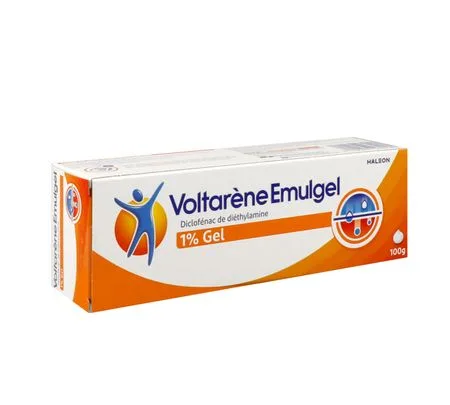
VOLTARENE EMULGEL 1 %, gel
Composition
Diclofenac diethylamine..........................................................................................................................1,16 g
Quantity corresponding to diclofenac sodium..........................................................................................1,00 g
For 100 g of gel.
Excipients with known effect: Perfume, Propylene glycol (50 mg/g of gel), Benzyl benzoate (1 mg/g of gel).
Diethylamine, carbomer 974 P, cetomacrogol 1000, ester of caprylic and capric acids with fatty alcohol of C12 to C18, isopropyl alcohol, liquid paraffin, cream perfume 45*, propylene glycol, purified water.
*Composition of cream perfume 45: lavandin essential oil, Brazilian rosewood essential oil, lavender essential oil, benzyl alcohol, terpenyl acetate, geraniol, benzyl benzoate.
Indications
In adults (from 15 years of age):
• Short-term local treatment in case of minor trauma: sprain (strain), contusion;
• Adjunctive local treatment of pain of muscular and tendinous-ligamentous origin;
• Symptomatic treatment of painful flare-ups of osteoarthritis, after at least one medical opinion.
Dosage and administration
Dosage
Reserved for adults (from 15 years of age).
The dosage depends on the indication. The occurrence of undesirable effects can be minimised by using the lowest possible dose for the shortest treatment duration necessary to relieve symptoms (see section Warnings and precautions).
Minor trauma: sprain (strain), contusion
1 local application, 2 to 3 times a day, for a maximum duration of 4 days. If the pain persists beyond this, a doctor must be consulted.
On medical advice, the maximum duration of treatment is 7 days.
The dose administered at each application must not exceed 2,5 g of gel (i.e. approximately 6 cm of gel).
Pain of muscular and tendinous-ligamentous origin
As adjunctive treatment: 1 local application, 3 to 4 times a day, for a maximum duration of 7 days. If the pain persists beyond this, a doctor must be consulted.
On medical advice, the maximum duration of treatment is 14 days.
The dose administered at each application must not exceed 2,5 g of gel (i.e. approximately 6 cm of gel).
Painful flare-ups of osteoarthritis
Only after at least one medical opinion.
1 local application, 3 to 4 times a day, for a duration of 7 days. Treatment may be continued, if necessary, for a maximum duration of 14 days. If the pain persists beyond this, a doctor must be consulted.
The dose administered at each application must not exceed 4 g of gel (i.e. approximately 10 cm of gel).
Special populations
Paediatric population
VOLTARENE EMULGEL 1 %, gel is contraindicated in children aged less than 15 years (see section Contraindications).
Elderly patients
This medicine should be used with caution in elderly people who are more prone to adverse effects (see sections Warnings and precautions and Adverse effects).
Method of administration
Topical use.
Work the gel in with a gentle, prolonged massage over the painful or inflamed area.
After application:
• Hands should be wiped with absorbent paper (for example), then washed (except in case of a flare-up of finger osteoarthritis, see section Warnings and precautions). The absorbent paper must be thrown in the bin after use and not in the toilet, to prevent the product from entering the wastewater system.
• If too large a quantity of gel is applied, the excess must be wiped off with absorbent paper.
• Before dressing or applying a non-occlusive bandage, it is advisable to let the gel dry for a few minutes on the skin.
• If patients need to shower or take a bath, they must apply the product afterwards.
Contraindications
This medicine is contraindicated in the following cases:
• Hypersensitivity to the active substance or to any of the excipients listed in section Composition.
• Pregnancy, from the beginning of the 6th month (beyond 24 weeks of amenorrhoea) (see section Fertility, pregnancy and breastfeeding).
• Damaged skin, whatever the lesion: weeping dermatoses, eczema, infected lesion, burn or wound.
• History of asthma, angioedema, urticaria or acute rhinitis triggered by diclofenac or a substance with a similar activity such as acetylsalicylic acid or other non-steroidal anti-inflammatory drugs (NSAIDs).
• In children and adolescents under 15 years of age.
Warnings and precautions
Special warnings
Do not apply to mucous membranes, nor to the eyes.
The appearance of a skin rash after application requires immediate discontinuation of treatment.
This medicine contains propylene glycol (50 mg/g of gel) and may cause skin irritation.
Due to the presence of benzyl benzoate (1 mg/g of gel), this medicine may cause irritation of the skin, eyes and mucous membranes through immediate non-immunological contact reactions with a possible cholinergic mechanism.
This medicine contains fragrance with benzyl alcohol, geraniol, citral, citronellol, coumarin, d-limonene, eugenol, farnesol and linalool, which may cause allergic reactions. In addition to allergic reactions in sensitized patients, non-sensitized patients may become sensitized.
Special precautions for use
Wearing gloves by the physiotherapist, in case of intensive use, is recommended.
Interactions
Due to the low systemic absorption during normal use of the gel, the drug interactions reported for diclofenac per os are unlikely.
Fertility, pregnancy and breastfeeding
Pregnancy
Inhibition of prostaglandin synthesis by NSAIDs may affect the course of pregnancy and/or the development of the embryo or foetus.
Risks associated with use during the 1st trimester
Epidemiological study data suggest an increased risk of miscarriage, cardiac malformations and gastroschisis after treatment with a prostaglandin synthesis inhibitor in early pregnancy. The absolute risk of cardiovascular malformation increased from less than 1% in the general population to approximately 1,5% in women exposed to NSAIDs. The risk appears to increase with dose and duration of treatment. In animals, administration of a prostaglandin synthesis inhibitor has been shown to cause increased pre- and post-implantation loss and increased embryo-foetal lethality. In addition, a higher incidence of certain malformations, including cardiovascular ones, has been reported in animals that received a prostaglandin synthesis inhibitor during the organogenesis phase of gestation.
Risks associated with use from the 12th week of amenorrhoea until birth:
• From the 12th week of amenorrhoea and until birth, all NSAIDs, through inhibition of prostaglandin synthesis, may expose the foetus to functional renal impairment:
- in utero, which may be observed from 12 weeks of amenorrhoea (onset of fetal diuresis): oligohydramnios (most often reversible on stopping treatment), or even anhydramnios, particularly with prolonged exposure.
- at birth, renal failure (reversible or not) may persist, particularly in cases of late and prolonged exposure (with a risk of delayed severe hyperkalaemia).
Risks associated with use beyond the 24th week of amenorrhoea until birth:
Beyond the 24th week of amenorrhoea, NSAIDs may expose the foetus to cardiopulmonary toxicity (premature closure of the ductus arteriosus and pulmonary arterial hypertension). Constriction of the ductus arteriosus may occur from the beginning of the 6th month (beyond the 24th week of amenorrhea) and may lead to fetal or neonatal right heart failure or even intrauterine fetal death. This risk is all the greater the closer the intake is to term (lower reversibility). This effect exists even for a single intake.
At the end of pregnancy, the mother and the newborn may present:
• prolonged bleeding time due to an anti-aggregant action that may occur even after administration of very low doses of the medicine;
• inhibition of uterine contractions resulting in delayed term or prolonged labour.
Consequently:
Unless absolutely necessary, this medicine must not be prescribed to a woman who is planning a pregnancy or during the first 5 months of pregnancy (first 24 weeks of amenorrhea). If this medicine is administered to a woman wishing to become pregnant or who is pregnant for less than 6 months, the dose should be as low as possible and the duration of treatment as short as possible. Prolonged use is strongly discouraged.
From the beginning of the 6th month (beyond 24 weeks of amenorrhea): any intake of this medicine, even a single dose, is contraindicated. Accidental intake from this date warrants cardiac and renal, fetal and/or neonatal monitoring depending on the term of exposure. The duration of this monitoring will be adapted to the elimination half-life of the molecule
Breast-feeding
As NSAIDs pass into breast milk, this medicine is not recommended for women who are breastfeeding.
In case of breastfeeding, this medicine must under no circumstances be applied to the breast.
Fertility
As with all NSAIDs, the use of this medicine may temporarily impair female fertility by affecting ovulation; it is therefore not recommended for women wishing to conceive a child. In women having difficulty conceiving or undergoing fertility testing, discontinuation of treatment should be considered.
Adverse effects
Adverse effects are listed in order of decreasing frequency, according to the following conventions: very common (≥1/10); common (≥1/100 to <1/10); uncommon (≥1/1000 to <1/100); rare (≥1/10 000 to <1/1000); very rare (<1/10 000), frequency not known: cannot be estimated from the available data. Within each frequency grouping, adverse effects are presented in order of decreasing seriousness.
|
System organ class |
Adverse reaction |
Frequency |
|
Infections and infestations |
Pustular rash |
Very rare |
|
Immune system disorders |
Angioedema (Quincke's edema hypersensitivity reactions (including urticaria) |
Very rare |
|
Respiratory, thoracic and mediastinal disorders |
Asthma attack* |
Very rare |
|
Skin and subcutaneous tissue disorders |
Dermatitis (including contact dermatitis), skin rashes, erythema, eczema, pruritus. |
Common |
|
Bullous dermatitis |
Rare |
|
|
Photosensitivity reactions, purpura and local ulceration |
Very rare |
* The occurrence of asthma attacks may be linked in some subjects to an allergy to aspirin or an NSAID. In this case, this medicine is contraindicated.
Other systemic effects of NSAIDs: they depend on the transdermal passage of the active ingredient and therefore on the quantity of gel applied, the surface area treated, the degree of skin integrity, the duration of treatment and whether or not an occlusive dressing is used (digestive and renal effects).
Reporting of suspected adverse reactions
Reporting suspected adverse reactions after authorisation of the medicinal product is important. It allows continued monitoring of the benefit/risk balance of the medicinal product. Healthcare professionals are asked to report any suspected adverse reaction via the national reporting system: National Agency for the Safety of Medicines and Health Products (ANSM) and the network of Regional Centres of Pharmacovigilance - Website: https://signalement.social-sante.gouv.fr/
Overdose
In case of overdose, wipe off excess gel with absorbent paper then rinse thoroughly with water.
In case of accidental or deliberate ingestion, effects similar to those observed in oral diclofenac overdose and resulting in adverse effects may occur. The therapeutic measures required are those generally adopted in cases of NSAID poisoning. The recommendations to follow will be those indicated by the regional Poison Control Centre, depending on the quantities ingested and the characteristics of the patient.
Pharmacodynamics
Pharmacotherapeutic class: NON-STEROIDAL ANTI-INFLAMMATORY DRUG FOR TOPICAL USE
ATC code: M02AA15
Diclofenac is a non-steroidal anti-inflammatory drug (NSAID), derived from phenylacetic acid of the arylcarboxylic acid group, with analgesic, anti-inflammatory and antipyretic properties. As with all NSAIDs, the exact mechanism of action of diclofenac is not fully elucidated but is essentially based on inhibition of prostaglandin biosynthesis, substances playing a major role in the genesis of inflammation, pain and fever, through inhibition of both cyclooxygenases (COX-1 and COX-2).
In gel form, it has local anti-inflammatory and analgesic activity.
Pharmacokinetics
Applied locally in gel form, diclofenac is absorbed through the skin.
Absorption
The quantity of diclofenac absorbed through the skin is proportional to the treated surface area and depends both on the total dose applied and on the degree of skin hydration.
The systemic passage of the gel, compared with that of oral forms of diclofenac in healthy volunteers, is of the order of 6 %, estimated from its urinary excretion and that of its hydroxylated metabolites, after single administration. Occlusion for 10 hours leads to a threefold increase in the quantity of diclofenac absorbed.
The systemic passage of the gel, compared with that of oral forms of diclofenac in healthy volunteers, is of the order of 13,9% after repeated administration.
The concentrations measured in synovial fluid, as well as in synovial tissue, are 40 times higher than plasma concentrations.
Distribution
Diclofenac concentrations were measured in plasma, synovial tissue and synovial fluid after topical administration of the gel to the joints of the hand and knee. Maximum plasma concentrations are approximately 100 times lower than those measured after oral administration of the same amount of diclofenac. 99,7 % of diclofenac is bound to serum proteins, mainly albumin (99,4 %).
Diclofenac accumulates in the skin, which acts as a reservoir from which the drug is released in a sustained manner into the underlying tissues. From there, diclofenac is distributed and persists preferentially in deep inflamed tissues, such as the joint, where it is found at concentrations up to 20 times that measured in plasma.
Biotransformation
The biotransformation of diclofenac involves in part glucuro-conjugation of the intact molecule, but essentially single and multiple hydroxylation of several phenolic metabolites, the majority of which are converted into glucuronide conjugates. Two of the phenolic metabolites are biologically active, but to a lesser extent compared with diclofenac.
Elimination
The total systemic clearance of diclofenac from plasma is 263 ± 56 ml/min. Terminal plasma half-lives are 1 to 2 hours. Four of the metabolites, including the two active metabolites, also have short plasma half-lives ranging between 1 and 3 hours. One metabolite, 3'-hydroxy-4'-methoxy-diclofenac, has a longer half-life but is practically inactive. Diclofenac and its metabolites are excreted mainly in the urine.
Characteristics in patients
No accumulation of diclofenac and its metabolites is expected in patients with renal impairment. In patients with chronic hepatitis or non-decompensated cirrhosis, the kinetics and metabolism of diclofenac are the same as in patients without hepatic impairment.
Preclinical safety
Acute toxicity, repeated-dose toxicity, genotoxicity and carcinogenicity studies revealed no risk related to the use of diclofenac at therapeutic doses in humans. No teratogenic potential of diclofenac was detected in mice, rats or rabbits. Diclofenac had no effect on fertility in rats; the prenatal, perinatal and postnatal development of the offspring was not affected.
Studies have shown that diclofenac diethylamine 1,16 g/100 g in gel form is well tolerated. No phototoxic potential was observed in mice and guinea pigs with diclofenac diethylamine 1,16 g/100 g in gel form, and the latter does not cause skin sensitisation in guinea pig tests.
Special storage precautions
Store at a temperature not exceeding 25°C for the varnished aluminium tube.
Store at a temperature not exceeding 30°C for the aluminium laminate tube.
Prescription, supply and reimbursement
| Marketing authorisation (AMM) |
|
| Price: |
|
Social Security reimbursement at 30% (T/100g) in the indications:
- Indication(s) listed in the marketing authorisation at the date of publication of this order (T/100g)
Collection.
23 RUE FRANCOIS JACOB
92500 RUEIL-MALMAISON
Tel (toll-free number): 0810 130 140
sg.serviceclientsgsk@haleon.com
https://www.haleon.com/
Source: VIDAL · Updated on 11/11/2026. This information does not replace advice from a healthcare professional.