
Professional product catalogue
Digestion & bowel function
Reflux, constipation, nausea, vomiting and diarrhoea concern different digestive functions. Gastric secretion, intestinal movement, water exchange and the nerve signals involved in vomiting do not share one mechanism. Antacids, laxatives, antiemetics and antidiarrhoeals consequently have distinct targets and formulations. Powders, liquids, chewable tablets and gastro-resistant forms help explain those differences beyond the broad expression digestive comfort and the nutritional products sometimes associated with the same setting. Anatomy provides a connection while each medicine retains its particular pharmaceutical function.
Products in this category
1,007 products
 Sandoz
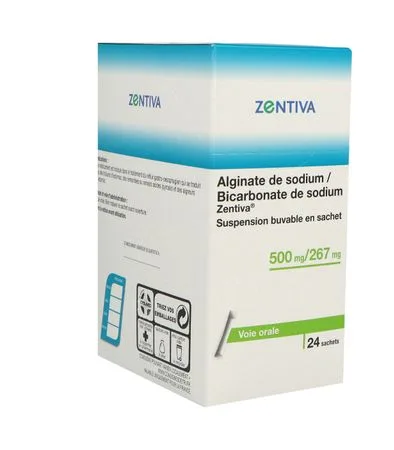
SODIUM ALGINATE/SODIUM BICARBONATE SANDOZ 500 mg/267 mg Oral suspension sachet 24Sachet/10ml
CIP / EAN : 3400927927034
 Viatris Santé
SODIUM ALGINATE/SODIUM BICARBONATE VIATRIS Oral suspension sachet 24Sachet/10ml
CIP / EAN : 3400927909924
 Amgen SAS
AMGEVITA 40 mg Solution for Injection in Prefilled Syringe (100 mg/mL) 2Syringe/0,4mL
CIP / EAN : 3400930294482
- Amgen SAS
AMGEVITA 40 mg Injectable Solution prefilled syringe (100 mg/ml) 6Syringe (3x2)/0,4ml
CIP / EAN : 3400930294499
























Understanding digestion & bowel function
Gastric acidity and reflux
Gastro-oesophageal reflux describes gastric contents moving back towards the oesophagus. Acidity is a property of those contents, rather than the name of a digestive movement. Medicines in this field include different approaches: neutralising acid, forming a barrier with certain alginates, or reducing acid secretion. Antacid and proton pump inhibitor consequently describe distinct mechanisms. Formulation also matters, including gastro-resistant characteristics of certain preparations. These features contribute to pharmaceutical interpretation and should not be reduced to a visual difference between tablets, capsules or products described with similar everyday digestive terminology.
Understanding bowel-function medicines
Constipation and diarrhoea concern stools and their passage but cover very different situations. Bulk-forming, osmotic, stimulant and locally acting laxatives do not have one identical pharmacological description. Similarly, an antidiarrhoeal acting on motility differs from a medicine whose action concerns secretion. These mechanisms are interpreted separately from the acute or chronic context of a disorder. Symptomatic treatment also does not establish activity against an infectious cause, which belongs to other medicine families and requires its own clinical interpretation rather than being inferred from a digestive category name.
Nausea and vomiting
Antiemetics relate to several digestive and nervous signalling pathways. Some settings concern prevention of vomiting associated with a treatment or an operation; others concern an established episode. Families and indications therefore cannot be inferred from nausea alone. The dedicated category distinguishes this field from antispasmodics, which address another process, and from acid-related medicines. Orodispersible, liquid and injectable forms provide further information about pharmaceutical design and intended administration. They do not, independently of composition and authorisation, establish that different antiemetics have the same role across all such settings.
Digestive formulations and water balance
Powders intended for dissolution or dispersion differ from ready-prepared solutions and suspensions. A suspension contains particles distributed in a liquid, a structure distinct from a solution. Chewable tablets, capsules and rectal forms also have particular characteristics. Gastro-resistant preparations are designed to resist the gastric environment, which differs from prolonged release. Rehydration solutions have a water and electrolyte function rather than an antidiarrhoeal action on motility or secretion. Medicines, nutrition products and fibre supplements consequently retain different roles and statuses. Similar digestive terminology does not establish the same formulation, target or regulatory identity for all of them.
Frequently asked questions
How does an acidity medicine differ from a laxative?
An acidity medicine concerns gastric acid or secretion according to its family, while a laxative belongs to constipation medicines. Their targets and digestive functions differ.
Is a fibre supplement necessarily a medicinal laxative?
No. Fibre can be dietary or form part of a bulk-forming medicine. Status and composition distinguish products despite shared terminology.
Updated 10 November 2026
Sources and further reading